


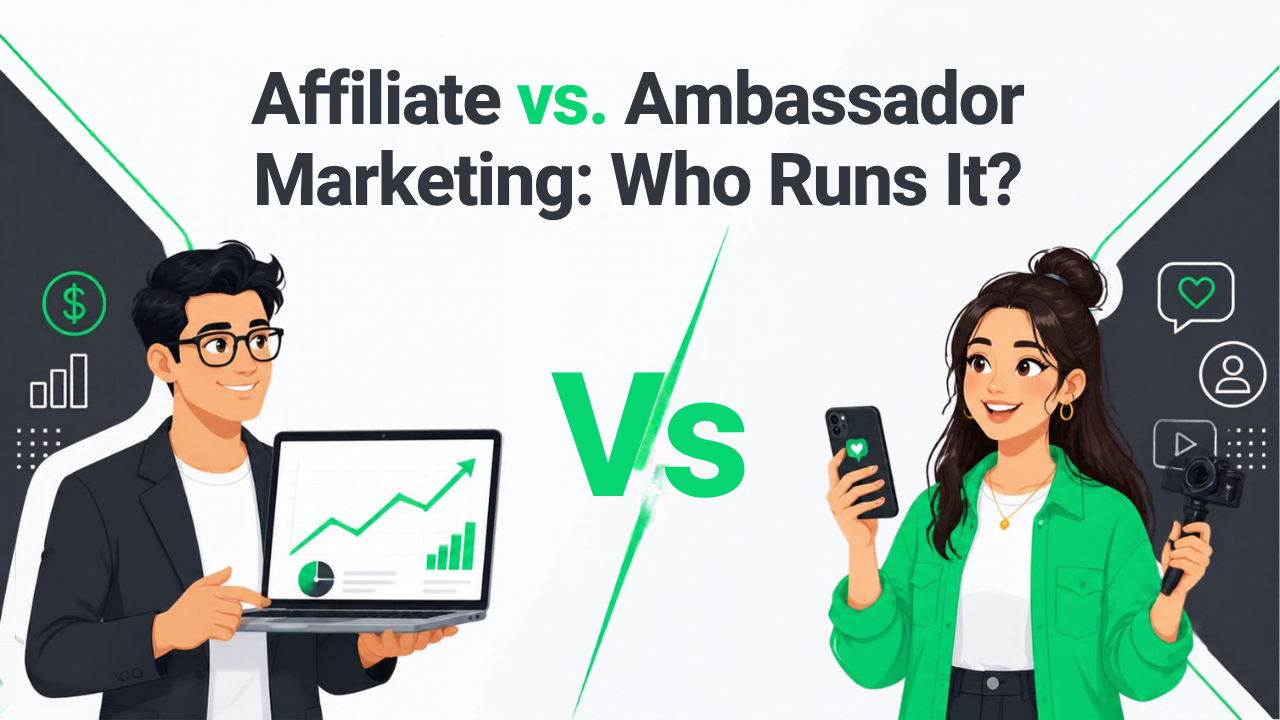
Affiliate and Ambassador Marketing for Supplement Brands: Should Your Ad Agency Run It, or a Specialist Platform?
Your supplement brand's DMs are full of creators asking to be an ambassador.
Your inbox has three affiliate platform pitches sitting unread.
And your ad agency keeps asking if you want to add influencer seeding to the mix.
Here is the real question nobody answers clearly: should your paid ads agency run this, or does it belong with a separate specialist?
We will break down the difference between affiliate and ambassador marketing, where each one actually helps a supplement brand grow, and exactly who should be driving the program so it does not become one more disconnected tactic.
Quick Look
Affiliate marketing pays creators a commission per sale, tracked by a link or code. It is performance-based and scales with revenue.
Ambassador marketing pays or gifts creators for ongoing content and loyalty, not just one sale. It builds brand presence over time.
Most supplement brands need both, run by two different skill sets, but connected to the same paid ads strategy so nothing gets wasted.
Affiliate and Ambassador Marketing Are Not the Same Thing
A lot of supplement brand owners use these words like they mean the same thing.
They do not.
An affiliate gets a unique link or code. They get paid a percentage only when someone actually buys through it. It is pure performance.
An ambassador gets a flat fee, free product, or a longer-term deal. They post regularly, show up in your content calendar, and represent the brand over months, not one transaction.
Both can work for a supplement brand. But they solve different problems, and that is exactly why the "who should run this" question matters so much.
| Factor | Affiliate | Ambassador |
|---|---|---|
| How they get paid | Commission per sale | Flat fee or product gift |
| Relationship length | Often one-off | Ongoing, months or longer |
| Main goal | Direct, trackable sales | Brand trust and content volume |
| Best skill set to manage it | Performance/affiliate platform | Creative or influencer specialist |
So, Should Your Paid Ads Agency Run This?
Here is the honest answer: partly, yes, but not the whole thing.
A good paid ads agency should not be the one chasing down affiliates, negotiating ambassador rates, or managing a creator community full time. That is a different job with a different rhythm.
But your agency absolutely should be the one deciding what happens to that content once it exists.
This is the part most supplement brands miss. Ambassador and affiliate content is not just a nice social post. It is some of the cheapest, most authentic creative a brand can get, and it is sitting there unused far too often.
Here is the move that actually works: treat your best ambassador and affiliate content the same way you treat UGC. Get the usage rights locked down, whitelist the top performers through Partnership Ads, and run it through the same testing process as your regular paid creative. We cover how to set that up properly in our guide on turning creator content into a real paid ads engine.
Without that step, you end up with two teams working in silos. One is recruiting creators. The other is buying ads. Neither is talking to the other, and your best organic content never makes it into your Meta or TikTok ad accounts where it could actually drive sales.
"The brands that win with affiliate and ambassador marketing are not the ones who recruit the most creators. They are the ones who turn that content into paid media fastest."
What a Specialist Platform Actually Does Well
Affiliate platforms and ambassador management tools exist for a reason. They are built for one job and they do it well.
A dedicated platform or specialist typically handles:
- Recruiting and vetting new affiliates or ambassadors at scale
- Generating and tracking unique codes or links accurately
- Automating commission payouts on a schedule
- Managing contracts, product shipments, and content calendars
- Handling the day-to-day creator relationship and communication
None of that is what a performance ad agency should spend its time on. Trying to do everything in-house with your agency usually means something gets dropped, and it is almost always either the creative testing or the compliance review.
The Model That Actually Works for Supplement Brands
The brands getting real results from this are not choosing one or the other. They are running a simple split.
A specialist platform or in-house community manager recruits, pays, and manages the affiliates and ambassadors.
Your paid ads agency reviews the content, checks it for compliance, and decides what gets whitelisted into paid spend.
Every few weeks, the two sides compare notes: which creators are actually driving sales, which content is worth boosting, and which relationships are not worth renewing.
That last part matters more than it sounds. Affiliate and ambassador programs generate a lot of noise. Without proper tracking, it is genuinely hard to tell which creators are driving real revenue versus which ones just look active. If your reporting is already shaky, this is worth fixing first. Our breakdown of why supplement agency ROAS numbers are often wrong covers the attribution gaps that hide this exact problem.
Compliance Still Applies Here
One more thing supplement brands forget: affiliates and ambassadors are still making claims about your product on your behalf.
If a creator says your supplement "cures" something or makes a health claim your label does not support, that is your brand's problem, not just theirs.
Before you scale any affiliate or ambassador program, make sure every creator agreement includes clear disclosure requirements and a simple list of claims they cannot make. A few hours of setup now saves a much bigger headache later.
A Simple Way to Start Without Overcomplicating It
You do not need a massive program on day one.
Most supplement brands do better starting small and proving the model before scaling spend on recruitment.
- Start with a small group of existing customers who already love the product. They convert better as affiliates than cold outreach ever will.
- Give your ads team a simple way to flag standout content for whitelisting, even if it is just a shared folder at first.
- Set a monthly check-in between whoever manages the program and whoever manages your ad spend, so nothing sits unreviewed for weeks.
- Review compliance language on creator agreements before you scale the number of people posting, not after.
Once that small loop is working, scaling the number of affiliates or ambassadors is just a matter of volume. The hard part, the review and testing process, is already built.
Questions to Ask Before You Add This to Your Mix
Before you sign up for a platform or hire a specialist, run through this short checklist with whoever manages your paid ads.
- Who will review content for compliance before it goes live, the platform or your agency?
- How will top-performing content get flagged and passed over for whitelisting?
- Does your agency have a process for testing organic creator content as paid ads?
- Who owns the usage rights once a creator's agreement ends?
- How often will affiliate or ambassador performance actually get reported back to you, separate from your regular ad reporting?
If nobody on your team can answer all five clearly, the program is probably going to run on its own island, disconnected from the paid media that is actually driving most of your revenue.
How We Handle This at eBrandX
We do not run affiliate recruitment as a full standalone service, and we think that is the right call. It is not our specialty, and we would rather be honest about that than overpromise.
What we do handle is the part that connects to paid media: reviewing creator and affiliate content for compliance, pulling the best performers into our regular creative testing process, and making sure nothing good gets left on the table just because it came from an affiliate link instead of a paid shoot.
For Amazon specifically, affiliate recruitment through Amazon's own Creator Connections program is already built into our full-service management at no extra charge, since it plugs directly into the same storefront and PPC work we are already doing.
If you already have affiliates or ambassadors posting and want to know whether that content is actually earning its spot in your ad account, that is a conversation worth having.
Want a second opinion on your supplement brand's creator and ad strategy?
Book a Free Strategy CallWant more breakdowns like this one, plus the templates and swipe files we actually use with clients? Our Supplements Scaling Insiders community is built for supplement brand owners who want to scale without guessing.
Affiliate and ambassador marketing is not a replacement for paid ads. It is fuel for them, if someone is actually connecting the two.