


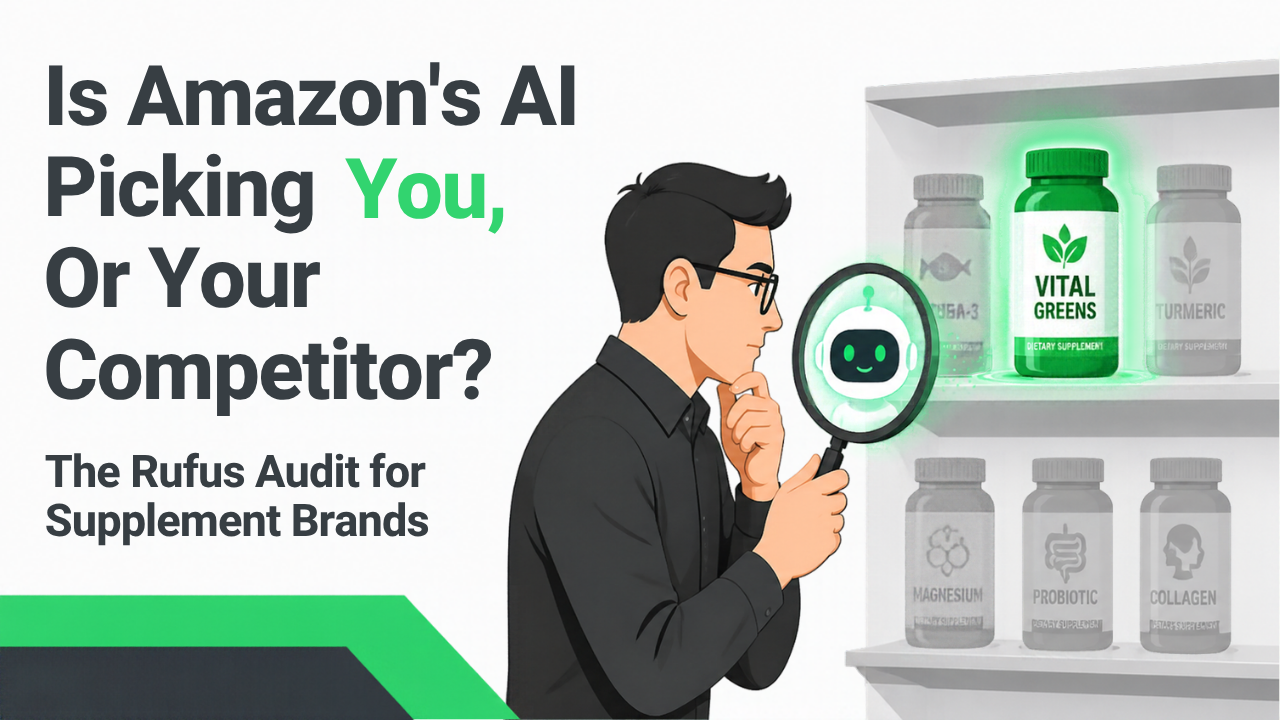
Amazon's Rufus AI Just Narrowed Your Shelf to 5 Products: Is Your Supplement Listed?
Amazon just changed how shoppers find your product, and most supplement brands have no idea it happened.
It is called Rufus, Amazon's AI shopping assistant.
In 2025, more than 250 million shoppers used it. During Black Friday weekend, it handled 38% of all Amazon shopping sessions.
Here is the part that should worry every supplement brand owner reading this. According to April 2026 research from Workflow Labs, Rufus does not show shoppers a wall of 50 search results anymore. It picks about five products and recommends those instead.
If your product is not one of the five, Rufus never mentions it. The shopper never scrolls past it. It is not that you ranked low. You simply were not part of the conversation.
Quick Look
Rufus now filters Amazon's results down to roughly 5 recommended products per search, not 50.
It reads your backend attribute fields more heavily than your front-end bullet copy, and most brands leave about half of those fields blank.
Sponsored prompts inside Rufus went from free beta to billable, cost-per-click ads on March 25, 2026.
Rufus can now buy automatically for a shopper once a target price hits, which means a missed recommendation can mean a lost sale with no second chance.
What Actually Changed Inside Amazon
Rufus is not one single algorithm. It runs on three layers working together.
The first is A10, Amazon's older ranking system. It still looks at sales velocity, click-through rate, and keyword matching, the things most supplement brands already optimize for.
The second is COSMO, a semantic knowledge graph that reads intent. A shopper can type "something for afternoon energy without the jitters" and COSMO can match that to your product even if your title never uses those exact words, as long as your backend attributes classify it correctly.
The third is Rufus itself, the conversational layer. It pulls from your reviews, your Q&A section, and how coherent your listing actually is, then decides what to say out loud to the shopper.
Most brands only ever optimize for the first layer. That is the problem.
| Rufus, By the Numbers | What It Means for You |
|---|---|
| Monthly active users up 149% year over year | This is not a niche feature anymore. It is becoming the default way people shop on Amazon. |
| Rufus shoppers show 60%+ higher purchase completion | Getting recommended converts unusually well. Getting skipped costs you more than a normal missed impression. |
| Recommended products carry a median of 4.5 stars and 2,991 reviews | New and under-reviewed supplement SKUs are starting at a real disadvantage. |
| 94.2% of recommended products use FBA, 92.1% are Prime eligible | Fulfillment method is quietly part of the filter, not just an operations choice. |
"Amazon provides no public Rufus API. There is no dashboard that tells you why you were not one of the five products shown. The only reliable signal is whether your backend data gives the AI a reason to pick you."
Why This Hits Supplement Brands Harder Than Most Categories
Supplement listings already carry more backend complexity than almost any other category on Amazon. Certifications, serving sizes, allergen flags, ingredient callouts, and compliant structure/function language all live in fields most sellers never finish filling out.
A 2024 Amalytix study of over 1,300 Rufus-recommended products found something brands in this category cannot ignore. Rufus essentially never recommended a product rated below 4.0 stars.
For a newer supplement brand still building review volume, or a brand carrying a few 3-star reviews from an old formula version, that is not a small gap to close. It can mean the AI assistant simply does not mention you, ever, regardless of how good your ads are.
There is also a paid layer now. Sponsored Products and Sponsored Brands prompts inside Rufus moved from a free beta to billable cost-per-click bidding on March 25, 2026. That means the brands who show up organically keep their edge, and the brands who do not are now being asked to pay for placement they used to get through good listing hygiene alone.
This is exactly the kind of channel shift we track closely for clients, the same way we have covered Amazon DSP as a channel worth evaluating for the right brand. Rufus is different though. It is not optional ad inventory you choose to add. It is already filtering how every shopper sees your listing, whether you opted in or not.
The Rufus Readiness Audit: 7 Things to Check Before Your Competitor Does
Here is the same audit sequence we run on a client's Amazon presence before we touch a single ad dollar.
- Backend attribute completion. Workflow Labs found most brands leave roughly half of these fields empty. COSMO reads them more heavily than your bullet points.
- Review rating floor. Anything sitting near or below 4.0 stars needs a review generation plan before anything else matters.
- Review volume and recency. The median recommended product carries almost 3,000 reviews. A trickle of reviews a month will not close that gap.
- Q&A coverage. Rufus pulls directly from your Q&A section when it answers a shopper's question in conversation. An empty Q&A tab is a missed opportunity to speak for your product.
- Listing content accuracy. Profitero audits reportedly found that more than half of brands' live listing content contained errors. An AI system has no patience for a mismatched title and bullet set.
- Fulfillment and stock signals. FBA participation, Prime eligibility, and consistent in-stock status all showed up heavily in recommended listings.
- Sponsored prompt budget. If you are not winning organically yet, a small, controlled test budget for Sponsored Products prompts inside Rufus is worth planning for now, before the cost per click climbs as more advertisers catch on.
If you only fix one thing this month, fix your backend attributes. Front-end copy is what shoppers read. Backend data is what the AI actually reads, and it is the part almost every supplement brand neglects.
Where This Fits Into a Bigger Compliance and Account Picture
Rufus readiness does not live on its own. It sits right next to the same account health questions we walk through on every compliance audit we run before we touch a client's ads, and the same structural checks we use in a full ad account audit on the Meta side.
The brands that stay ahead are not the ones scrambling after a ranking drop. They are the ones who treat listing data, reviews, and compliance as one connected system instead of three separate chores handled by three different people.
This is exactly the kind of audit eBrandX runs for supplement brands before we ever launch a campaign. We go through backend attributes field by field, flag compliance risk in your claims language, and map out a review generation plan that actually moves your star rating, not just your sales numbers.
If you want a second set of eyes on whether your top sellers would make Rufus's list of five, book a free strategy call and we will walk through it together.
Want eyes on your Amazon listings before your competitor gets there first?
Book Your Free Strategy CallWant the deeper playbooks behind posts like this one? Our Supplements Scaling Insiders community breaks down exactly how we run these audits, with templates and swipe files for Amazon, Meta, and TikTok Shop.
Rufus is not going away. It is only going to filter harder as more advertisers compete for the same five slots. The brands that fix their backend data now will be the ones Rufus is still recommending a year from now.