


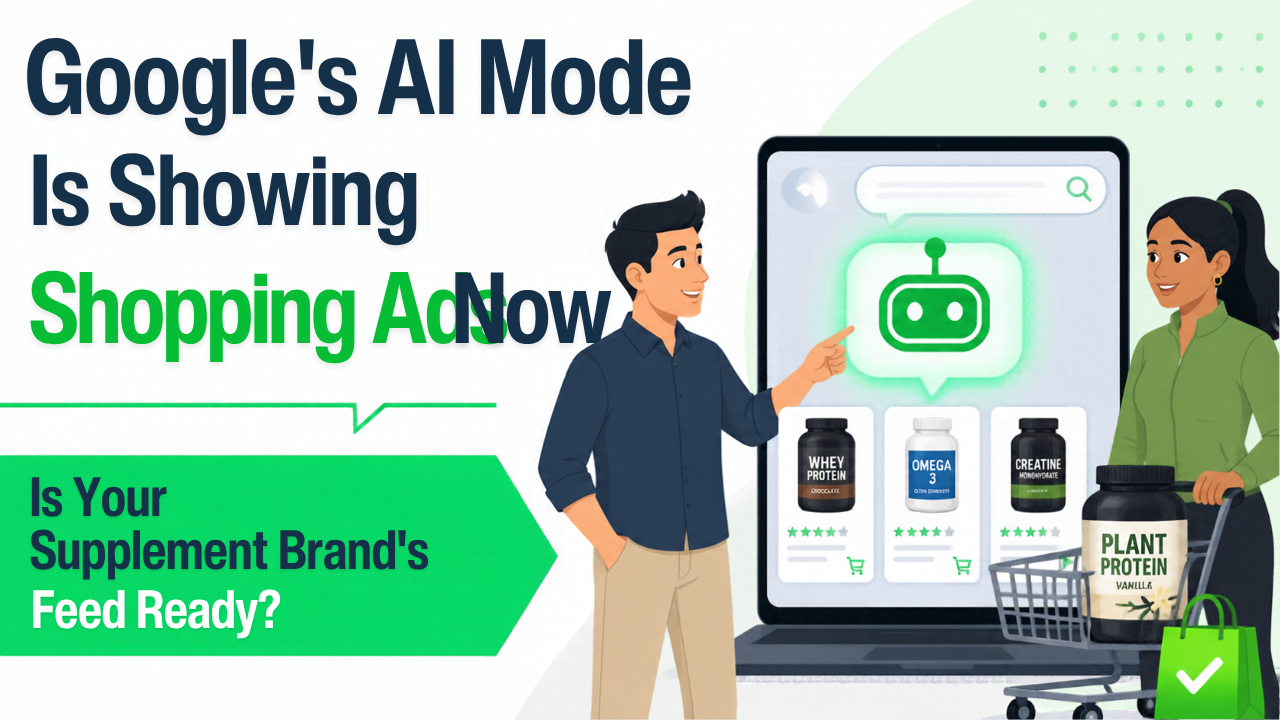
Google's AI Mode Is Showing Shopping Ads Now: Is Your Supplement Brand's Feed Ready?
Google just changed where your supplement brand's ads can show up.
As of August 2026, Google Shopping ads are now appearing inside AI Mode, the conversational search experience that has already passed 1 billion monthly users.
That is not a small test anymore. It is a real ad surface, and it works differently than anything your agency has optimized for before.
Here is what changed, why it matters more for supplement brands than most categories, and the exact feed checks to run before Q4 demand peaks.
Quick Look
What happened: Google confirmed Shopping ads now appear in carousel format inside AI Mode responses, plus a second ad unit at the bottom of the response.
How eligibility works: Gemini builds the ad straight from your Merchant Center feed (title, description, images, price, availability). There is no separate ad to write.
Why supplement brands should care: Your product descriptions, the same ones FTC and FDA rules already apply to, are now the raw material an AI uses to describe your product to a shopper. A sloppy or overclaiming feed description is now a compliance risk and an ad, at the same time.
What to do: Audit your top SKUs' feed data this week, before the holiday demand window closes.
What Actually Changed Inside AI Mode
Google's AI Mode is the conversational version of search. A shopper types a longer, more specific question instead of three keywords.
Google's own research found people write queries two to three times longer in AI Mode than in regular search. That is a lot more buying intent packed into one query.
Until recently, brands could only show up in that conversation organically. Now, sponsored Shopping ads appear directly inside the AI-generated answer, labeled as ads, sitting right next to the product recommendations Gemini writes itself.
There is no new campaign type to build. AI Mode placements run through your existing Shopping and Performance Max campaigns, billed the same way, on cost per click.
That sounds convenient. It also means most brands will get this placement by default, whether their feed is ready for it or not.
Why This Is a Bigger Deal for Supplement Brands Specifically
For most product categories, this is a feed-quality problem. For supplement brands, it is also a claims problem.
Gemini writes its shopping summary directly from your title, description, and attributes in Merchant Center. If your feed description says your product "cures," "treats," or "reverses" something, that is no longer just risky website copy.
It is now language an AI system can surface, inside an ad, to a shopper actively comparing products. That is a much faster path to a flagged account than a slow-moving organic listing ever was.
We have already covered how structure/function claims work under FDA rules in detail in our guide to FDA structure/function claims for supplement ads. The same rules now apply to your product feed, not just your ad copy and landing page.
The compliance surface just got bigger. Any team member who edits Merchant Center feed descriptions without compliance training is now, functionally, writing ad copy. Treat your feed like ad creative, because Google's AI now treats it that way.
The Feed Attributes That Decide If You Even Show Up
Gemini is not reading your ad copy. It is reading structured data. If an attribute is missing, thin, or vague, your product is simply less likely to get picked for the conversation.
| Feed Attribute | Why It Matters in AI Mode | Supplement-Specific Note |
|---|---|---|
| Product title | Gemini scans it first for relevance signals | Lead with form (capsule, gummy, powder) and primary ingredient, not a slogan |
| Description | Descriptions under roughly 150 characters tend to get skipped for AI relevance matching | Write real sentences in plain language, and keep every claim compliant |
| Product type / category | Helps Gemini group you correctly against competitors | Be specific: "pre-workout powder," not just "supplement" |
| Images | Used in the carousel card shoppers actually see | Clean, label-forward product shots outperform lifestyle-only images here |
| Price and availability | Must match your own site exactly | Google's policy bans showing a higher price than your own website |
The 6-Step Feed Audit to Run This Week
This does not need to be a big project. It needs to happen before Q4 demand hits, because feed changes take time to reflect in the auction.
- Pull your top 50 SKUs by revenue and check them first. Do not try to fix your whole catalog at once.
- Open Merchant Center Diagnostics and flag every title, description, and attribute warning tied to those SKUs.
- Rewrite thin descriptions in plain, natural language. Lead with what the product is and who it is for, not a tagline.
- Run every rewritten description past your compliance checklist, the same one your ad copy already goes through. Feed copy is ad copy now.
- Check your Target ROAS or Target CPA settings. Overly aggressive targets can quietly exclude products from this placement entirely.
- Watch for the AI Mode placement breakdown landing in your Campaigns and Ad Groups reports, and track impression share from here forward as your early signal.
Should You Chase This Now, or Wait?
This is genuinely a middle-of-funnel decision, not an obvious yes for every brand.
Google has not published AI Mode-specific ROAS benchmarks yet. You are optimizing for a placement you cannot fully measure in isolation today.
That said, the feed hygiene work pays off even if AI Mode underperforms, because a cleaner feed also improves your regular Shopping and Performance Max results. There is very little downside to doing it.
The part worth waiting on is a big reallocation of budget specifically toward this placement. Wait for the placement-level reporting Google is rolling out before you draw hard conclusions about ROI.
Bottom line: Fix the feed now. Judge the channel later, once real reporting exists.
Where This Fits Into Your Bigger Ad Strategy
AI Mode Shopping ads are not a replacement for a solid Performance Max or Shopping strategy. They sit on top of it.
If you are still deciding how much of your Google budget should go toward Shopping and Performance Max in the first place, our guide to Google Shopping and Performance Max for supplement brands breaks down the risk and reward of that channel mix in detail.
A feed audit like this is exactly the kind of work we run during the first call with a new supplement brand, alongside a full look at claims, creative, and account history. You can see the full breakdown in our supplement ad compliance audit guide.
Most in-house teams are already stretched thin managing Meta, Amazon, and TikTok Shop. Adding "monitor a new AI-driven Google placement" to that list is exactly where a dedicated agency earns its retainer back fast.
Want a second set of eyes on your product feed before Q4 peaks?
eBrandX runs a full feed, compliance, and account check on the first call, free, no obligation.
Book Your Free Strategy CallPrefer to learn at your own pace first? Our free Supplements Scaling Insiders community covers feed, compliance, and channel strategy breakdowns like this one every week.
Google is not slowing down on AI-driven commerce. The brands that treat their product feed like real marketing collateral, not an afterthought, are the ones who will show up in these conversations first.