


Incrementality Testing for Supplement Brands: How to Know If Your Ads Are Actually Working in 2026
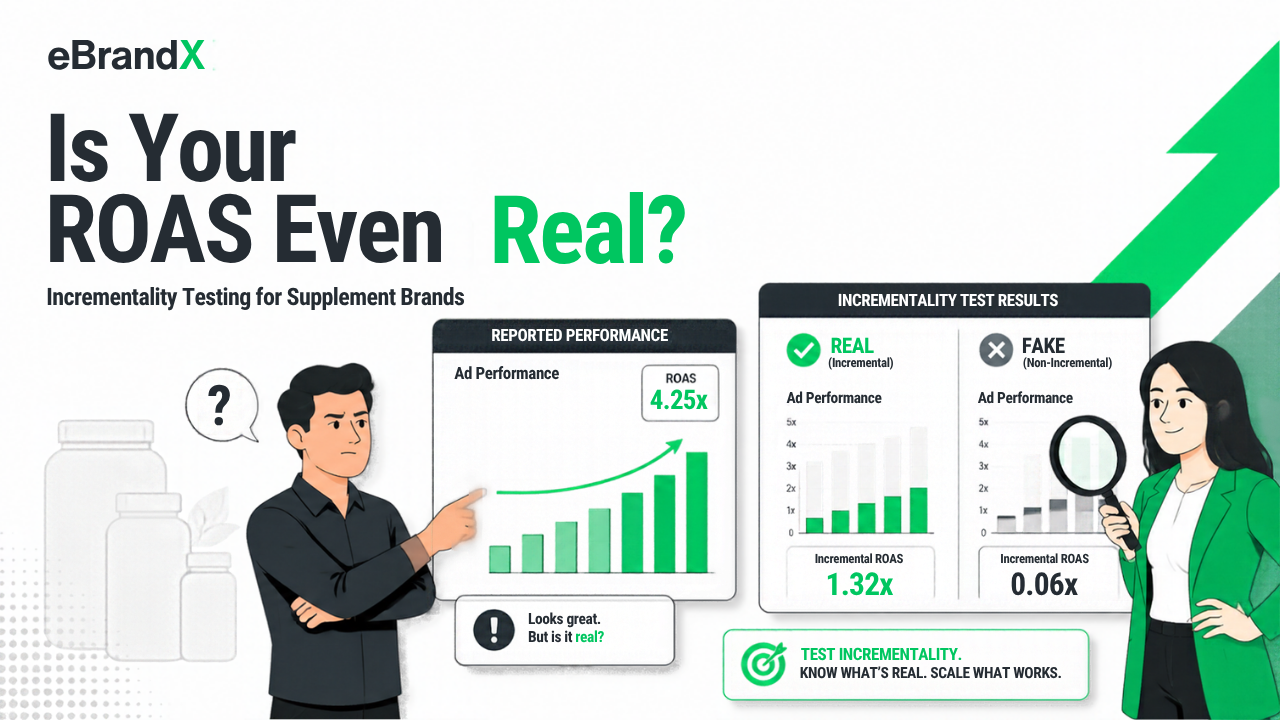
Your ad platform says your last campaign returned 4.2x ROAS. Your finance team runs the numbers a different way and gets something much smaller.
Both of you could be looking at the same campaign. Only one of you is measuring whether the ads actually caused any sales.
This is the gap between attribution and incrementality. In 2026, more supplement brands are finally asking their agencies to prove the difference.
Quick Look
Attribution tells you which touchpoint got credit. It does not tell you if the sale would have happened anyway.
Incrementality testing uses a real control group (a holdout) to measure the actual lift your ads create.
Incremental ROAS almost always runs lower than platform-reported ROAS. That is normal, not a red flag.
Google dropped the minimum budget for a valid incrementality experiment from roughly $100,000 to about $5,000, using Bayesian statistical models. That makes testing realistic for mid-sized supplement brands for the first time.
Why Your Platform's ROAS Number Can Lie to You
Attribution models assign credit. A customer sees a retargeting ad, clicks, and buys three days later.
The platform counts that as a win.
But what if that customer already had your product in their cart, or already follows your brand on Instagram, or was going to search your name anyway?
Attribution cannot answer that question. Only a controlled test can.
Incrementality testing solves this by holding a portion of your audience back from seeing the ad entirely, then comparing their behavior to the group that did see it. The difference between the two groups is your real, incremental lift.
"Incremental ROAS numbers run lower than traditional ROAS." That is how Kroger Precision Marketing described it to advertisers moving from attribution to true lift measurement. Brands used to last-touch numbers should expect their real figures to look smaller, not bigger.
Three Ways Brands Actually Run This Test
None of these require a data science team. They do require patience and a willingness to let a test finish before judging it.
| Test Type | How It Works | Typical Duration |
|---|---|---|
| Geo Holdout | Split markets into test and control regions. Run ads only in test markets, then compare sales lift. | 6 to 8 weeks for a standard DTC test |
| Time-Based Holdout | Turn campaigns on and off in set windows, then compare active periods to inactive ones. Useful for brands without geographic spread. | 4+ weeks per cycle |
| Matched Market | Pair similar markets and run different strategies in each, then compare results side by side. | Varies by campaign goal |
A full geo holdout test usually needs at least 20 markets (about 10 test, 10 control), each representing 15 percent or more of total sales, with a 4 to 8 week baseline period before the test even starts. Smaller brands without that scale typically lean on time-based or matched-market testing instead, or pool data through a testing partner.
Why Supplement Brands Need a Slightly Longer Window
Most incrementality guides are written for general ecommerce. Supplement brands have a quirk that changes the math: a lot of your real value shows up after the first order, not during it.
A customer who subscribes to a monthly protein powder or a daily multivitamin is worth far more over 6 months than their first checkout suggests. If your test window only measures the first purchase, you are measuring the wrong thing.
General DTC guidance suggests 6 to 8 weeks for a standard test and 12 or more weeks when purchase cycles run long. For a subscription-heavy supplement brand, leaning toward the longer end of that range is usually worth the extra patience.
Timing matters too. Running your first test during a Q4 promotion or a New Year resolution spike will give you a skewed number.
It will reflect seasonal demand more than it reflects your ads. A quieter month gives a much cleaner read.
Four Mistakes That Quietly Kill a Test
1. Ending the test early. Stopping before you reach statistical significance gives you a number that feels real but is not reliable.
2. Ignoring outside noise. A competitor's sale, a weather event, or a local news story can skew one market without you ever knowing.
3. Using too few markets. A test built on 3 or 4 markets is not statistically meaningful, no matter how clean the chart looks.
4. Letting markets contaminate each other. Customers travel, see ads online anyway, or hear about your product by word of mouth across the "control" line.
Why This Is Suddenly Worth Doing in 2026
For years, incrementality testing was something only brands spending six figures a month could afford to run.
That changed when Google dropped its minimum test budget from roughly $100,000 to around $5,000, using newer Bayesian models that need far less raw data to reach a confident answer.
At the same time, the rest of the industry is catching on. More than half of U.S. brand and agency marketers now report using incrementality testing in some form.
Over a third plan to increase that investment in the next year.
But adoption is still uneven. A third of CPG marketers say they only measure incrementality at a basic level.
The most common barriers are doubts about accuracy, the complexity of setting a test up correctly, and simply not having the right tools.
That gap is exactly where a lot of supplement brands are quietly losing budget to ads that look good on a dashboard and do very little in reality.
What To Ask Your Agency Before You Renew
If your agency's entire performance story is built on the ROAS number inside Meta Ads Manager or Google Ads, you are only hearing half the story.
That does not automatically mean your agency is doing a bad job. Attribution still matters for day-to-day optimization.
It just should not be the only lens anyone uses to decide whether a channel, campaign, or budget increase is actually working.
A few questions worth asking at your next check-in:
- Has anyone ever tested whether this channel's spend is incremental, or have we only ever looked at platform-reported ROAS?
- If we paused this campaign for four weeks, does anyone have a confident guess at what would happen to sales?
- Is our reporting built around attribution credit, or does it separate true lift from touches that just happened to be in the path?
This is part of why eBrandX builds structured performance reporting into every management retainer rather than treating it as an add-on. We have also written about how attribution windows alone can make your agency's ROAS numbers wrong, and what a genuinely good CAC and ROAS actually look like by sub-category, if you want the fuller picture before your next budget conversation.
If you are already auditing your account for other red flags, our 12-point Meta ads account audit is a good companion check before you add a formal incrementality test on top.
Not sure if your current ads are actually working, or just getting credit?
Book a free strategy call and we will walk through your current reporting, what it is actually proving, and where a real test would help.
Book Your Free Strategy CallWant to go deeper on measurement, creative testing, and agency red flags with other supplement brand owners doing the same thing? Our Supplements Scaling Insiders community covers exactly this kind of thing, with templates and real examples, not just theory.
Platform ROAS will always be the easiest number to pull up. It is just not always the true one.
Starting with one small test this quarter, even a basic time-based holdout, is enough to find out which number your brand has actually been trusting.