

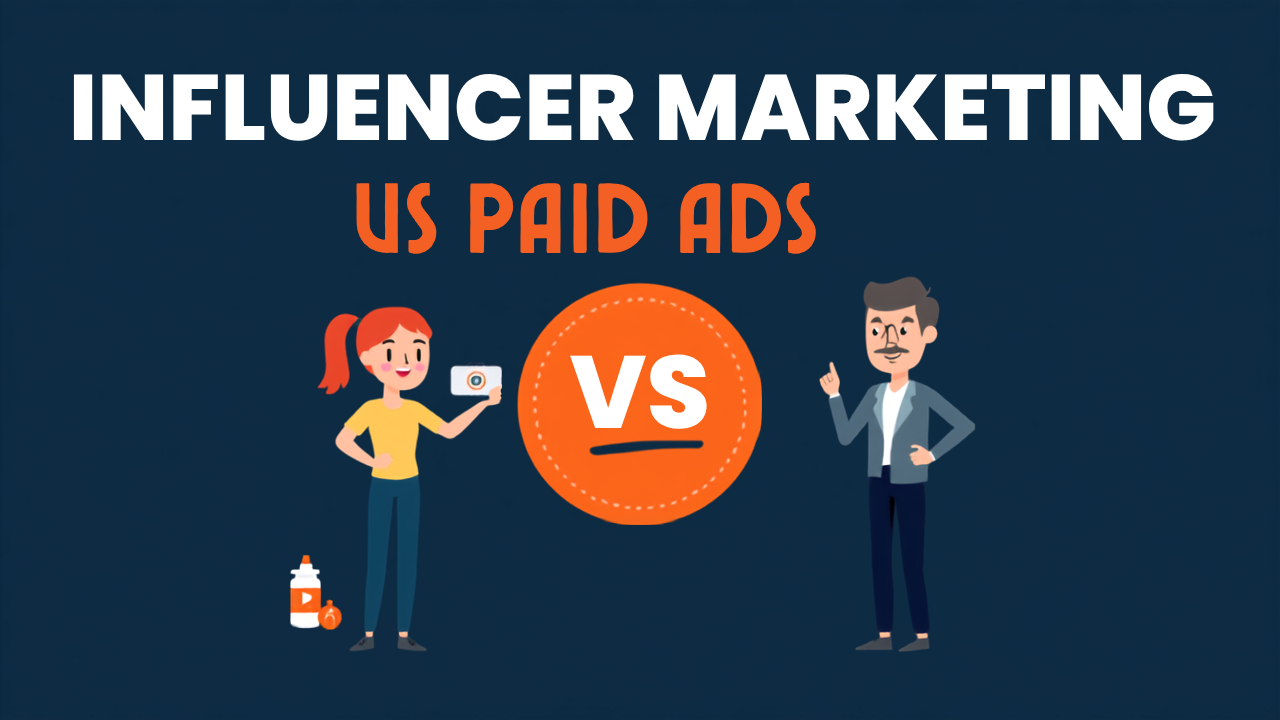
Influencer Marketing vs. Paid Ads for Supplement Brands: Where Should Your Budget Actually Go?
Every supplement brand hits this question eventually. Should you pay creators to post about your product, or should you put that money into paid ads instead?
It feels like a simple choice. It is not.
Influencer marketing and paid ads are not really competitors. They solve different problems. But most supplement brands never learn that, so they pick one, pour their whole budget into it, and wonder why growth stalls.
Quick Look
Influencer marketing builds trust and social proof, but it is slower and harder to scale on demand.
Paid ads give you speed and control, but they need good creative to work, and supplement ads face strict compliance rules.
The brands that grow the fastest in 2026 use influencer content as the raw material for paid ads, not as a separate channel.
What Influencer Marketing Actually Does for a Supplement Brand
Influencer marketing means paying a creator to talk about your product to their audience.
For supplement brands, this usually looks like a fitness creator, a wellness creator, or a health-focused mom account posting a video with your product.
The real value is not the reach. Reach is easy to buy. The real value is borrowed trust.
People trust a creator they already follow more than they trust a brand they just discovered. That trust is why a good influencer post can outperform a polished brand ad, especially in a category like supplements where people worry about safety and ingredients.
What Paid Ads Actually Do for a Supplement Brand
Paid ads are different. You are not borrowing someone else's audience. You are buying attention directly from the platform, on your own terms.
That gives you control an influencer post never will. You choose who sees the ad, how much you spend, and when it runs.
You can also test fast. Run five hooks on Monday, know which one is winning by Thursday, and kill the losers before they waste your budget.
The catch is that paid ads live or die on creative quality, and supplement ads carry extra compliance risk that other categories do not deal with. Say the wrong thing about what your product treats or cures, and Meta will restrict the whole ad account. We have written a full recovery playbook for that exact situation if it has already happened to you.
Influencer Marketing vs. Paid Ads: Side by Side
| Factor | Influencer Marketing | Paid Ads |
|---|---|---|
| Speed to launch | Slow (outreach, negotiation, content turnaround) | Fast (live within a day) |
| Cost control | Fixed fee, hard to predict ROI upfront | Adjustable daily, pause anytime |
| Trust factor | High (borrowed from the creator) | Lower on its own, higher with UGC-style creative |
| Scalability | Hard to scale on demand | Easy to scale up or down |
| Compliance risk | Lower, but FTC disclosure rules still apply | Higher, especially for health claims |
| Best for | Brand trust and top-of-funnel awareness | Direct response and predictable growth |
"The brands losing money are not the ones choosing wrong. They are the ones never treating this as one system."
Where Influencer Marketing Wins
Influencer marketing tends to win in a few specific situations.
1. You are launching a brand new product. Nobody trusts a product with zero reviews. A creator's endorsement fills that gap fast.
2. You need content, not just reach. A single influencer collaboration can produce raw footage you reuse for weeks.
3. Your ad account has compliance history. Organic influencer posts do not carry the same restriction risk as a rejected ad.
Where Paid Ads Win
Paid ads pull ahead in a different set of situations.
1. You need predictable, repeatable revenue. A good ad account is a machine you can turn up or down on purpose.
2. You want to know your numbers. Cost per purchase, return on ad spend, and lifetime value are all trackable in a way influencer posts rarely are.
3. You already have proof your product works. Ads convert best when you already know your offer, your hooks, and your audience. If you are still figuring that out, our Google Ads vs. Meta Ads breakdown is a good next read for where to actually spend that budget.
Three Mistakes Supplement Brands Make With Both Channels
Before you pick a channel, it helps to know how brands usually get this wrong. These three mistakes show up again and again.
Mistake one: chasing follower count instead of fit. A creator with 500,000 followers who does not actually care about wellness will convert worse than a creator with 15,000 followers who genuinely uses supplements. Relevance beats reach almost every time in this category.
Mistake two: launching ads with no creative testing plan. Brands often build one ad, spend a few hundred dollars, and decide paid ads "do not work" for them. One ad is not a test. It is a guess. Real testing means running several hooks against each other and measuring which one actually holds attention, which is exactly what our creative testing velocity guide walks through in detail.
Mistake three: treating an agency search the same for either channel. A creator-sourcing agency and a full paid ads agency are not the same thing, and hiring the wrong one wastes months. Our breakdown of UGC agencies vs. full-service ad agencies covers exactly how to tell the two apart before you sign anything.
The Real Answer: Stop Treating Them as Separate Channels
Here is what most supplement brands miss. The best influencer content should not stay on the influencer's page.
When you get proper usage rights, you can take that same creator video and run it as a paid ad through the creator's own account. This is called whitelisting or Partnership Ads, and it is one of the highest-performing creative formats in the supplement space right now.
You get the trust of influencer content and the targeting and scale of paid ads at the same time. We broke down exactly how this works, including the usage rights you need to get right first, in our guide to whitelisting UGC.
How to Split Your Budget: A Simple Starting Framework
- New brand, under $10k a month: Start 70 percent influencer content, 30 percent paid ads. You need trust and raw creative before you scale spend.
- Growing brand, $10k to $50k a month: Move to roughly 50/50. Start whitelisting your best-performing influencer content.
- Scaling brand, $50k a month and up: Shift to 30 percent influencer sourcing, 70 percent paid ads. By now, paid should be your main growth engine, fed by a steady pipeline of creator content.
These numbers are a starting point, not a rule. Your actual split should shift based on how fast your creative is fatiguing and how much room you have left in your budget. If you are not sure what a healthy ad budget even looks like at your revenue stage, our 2026 ad spend benchmark guide lays out real numbers by stage.
One warning before you start: the FTC requires clear disclosure on every paid influencer post, and Meta requires proper Branded Content tags on any whitelisted ad. Skipping either one is not a small mistake. It can get the creator's post removed, or worse, get your ad account flagged during review.
So, Which One Should You Actually Pick?
Neither, if you are asking which one to pick forever. The question is not influencer marketing or paid ads.
The real question is: which one first, and how fast do you connect them?
Most supplement brands waste six months figuring this out through trial and error, usually while burning ad spend on creative that was never built to convert in the first place. That is the exact gap eBrandX fills for supplement brands. We manage the full pipeline: sourcing creators, securing usage rights, building compliant paid creative, and running the media buy across Meta and TikTok, all under one roof.
Not sure where your budget should actually go? Book a free call and we will look at your current creative mix and tell you exactly where the gaps are. You are also welcome to swap notes with other founders in our Supplements Scaling Insiders community.
Your product does not need a bigger budget. It needs a system where influencer content and paid ads are working together instead of competing for the same dollars.