


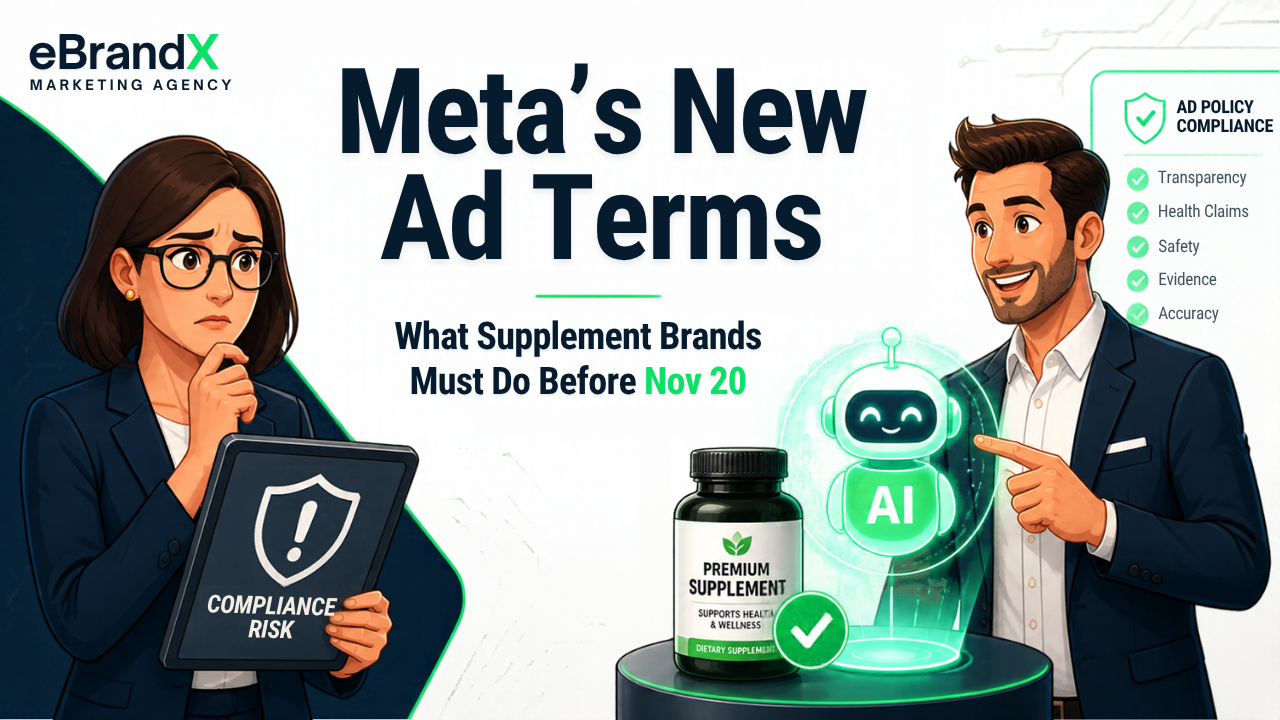
Meta's New Ad Terms: What Supplement Brands Must Do Before November 20
Meta just rewrote the rules for every brand running ads on Facebook and Instagram.
The new terms take effect November 20, 2026.
If you sell supplements, this update matters more to you than it does to almost any other category. Here is why, and what to do about it before the deadline.
Quick Look
What changed: Meta's updated Commercial Terms make advertisers solely responsible for anything its AI tools do to their ads, even features they never turned on.
Why supplement brands feel it more: AI can quietly rewrite your copy, translate a claim, or swap an image, and you are the one liable if that edited version crosses an FDA or FTC line.
Also in the terms: broader rights for Meta to crawl your website (landing pages, blog posts, product copy) and a narrow window to opt out of arbitration.
Deadline: November 20, 2026, and the terms apply just by continuing to advertise. There is nothing to sign.
What Actually Changed on November 20
Meta first announced updates to its Commercial Terms and Self-Serve Ad Terms on October 8, 2026.
The original effective date was October 30. Meta pushed it back to November 20, 2026 after pushback, but the substance did not change.
There is no checkbox, no signature, and no confirmation email.
You accept the new terms simply by continuing to run ads after the effective date.
The headline change: advertisers are now solely responsible for the risks created by Meta's AI tools acting on their ads, including features that were switched on automatically rather than something the brand chose to enable.
That covers Meta rewriting your ad copy, translating a claim into another language, generating a new image, picking its own targeting, or adding sitelinks you never built.
You also cannot remove the watermark or authentication metadata Meta attaches to AI-generated creative.
Why This Hits Supplement Brands Harder
Most ecommerce categories can absorb an AI typo or an odd auto-generated image.
Supplement brands cannot.
Your ad copy lives inside a narrow legal lane already. A structure/function claim like "supports healthy energy levels" is compliant. A claim that drifts into "cures fatigue" is not, and regulators do not care whether a human or an algorithm wrote it.
Real incidents reported since this policy rolled out show exactly how this goes wrong. One retailer's ad got auto-edited by Meta's AI into a bicycle with two handlebars. Agencies and brands have separately reported Meta adding unrequested sitelinks, auto-translations, and AI-generated product images to live ads without anyone asking for them.
| What Could Happen | Who Is Liable Now |
|---|---|
| AI auto-translates "supports immune health" into a disease claim in another market | The advertiser, not Meta |
| AI swaps a product shot and the new image implies an unapproved use | The advertiser, not Meta |
| Meta auto-enrolls an account in a creative feature nobody turned on | Still the advertiser |
Across 2026, roughly 14 percent of Meta ad rejections were tied to undisclosed AI content. That number only grows as more of these features turn on by default.
"The terms don't say which AI features are on by default or how to turn them off. Replacing creative or duplicating an ad can reselect the same enhancements you just switched off."
Meta Can Now Crawl More Than Your Product Catalog
The new terms give Meta, or parties acting on its behalf, broader permission to crawl domains tied to your business.
That is not limited to your product feed. It reaches landing pages, blog posts, collection descriptions, and campaign copy, and the terms say this can happen even through test credentials or sign-up walls.
Meta says robots.txt reflects your preferences. Its own crawler documentation says blocking the relevant token removes both search indexing and AI training at once, which is not the same as a brand being able to choose one without the other.
If your site has pages with ingredient formulations, internal pricing logic, or claims language you have not cleared yet, this is the moment to review what is actually crawlable.
The Arbitration Clause Most Brands Will Miss
US businesses are required to arbitrate commercial disputes with Meta individually rather than in court.
You can opt out, but only by sending written notice by mail to Meta Platforms in Menlo Park within 30 days of the date your business first accepted a version of the terms that included an arbitration clause.
Here is the catch. If your ad account already accepted an earlier version with this clause, that window likely closed long ago, without anyone at your company noticing it opened. A newly created legal entity accepting terms on or after November 20 may still have a live 30-day window. Worth checking per entity, not per account.
Your Pre-Deadline Checklist
This is not a "read it when you get time" situation. Here is the order to work through it in.
- This week: export every live ad with Advantage+ creative enhancements turned on, account by account.
- This week: set account-level creative defaults to off for anything your brand or legal team has not explicitly approved.
- This week: compare five recent live ads per account against their original approved versions, and keep that evidence on file.
- Before November 20: have whoever handles compliance review the AI liability clause against your existing claims language, especially anything structure/function related.
- Before November 20: put it in writing with your agency or internal team who reviews AI-modified creative before it goes live, and who owns the risk if it does not get caught.
- Before November 20: decide your position on the website crawling permissions, and loop in whoever manages your domain and gated content.
- After November 20: re-check every account after any creative swap, duplication, or format change going forward. Enhancements can quietly turn back on.
Where We See This Going Wrong
Most supplement brands we talk to are not ignoring compliance. They are relying on a review process that was built for human-written ad copy.
That process was never designed to catch an AI quietly swapping a word, a translation, or an image after the ad already went live. That gap is exactly what this policy update exposes.
How eBrandX Handles This for Clients
This is the same lane we already work in every day: supplement ad accounts, structure/function claims, and the specific ways Meta's automation can drift a compliant ad into a non-compliant one.
When we take on a new account, we run a full audit of every Advantage+ setting before a single dollar moves, not after. We also check accounts already live for the auto-enrollments this update makes everyone's problem.
If your current setup was built before this update existed, it is worth a second look now, not after an ad gets flagged. You can see exactly how we check this on the first call here: go.ebrandx.com/call.
For a deeper look at how we evaluate an existing Meta account for exactly these kinds of red flags, see our Meta Ads Account Audit checklist. If this is the second Meta compliance shift you have had to track this year, our breakdown of the July 2026 claims-review policy shift is worth reading alongside this one. And if an account has already been restricted over a claims issue, our recovery playbook walks through what to do next.
Not sure if your ad accounts are exposed?
Get a free compliance and account review before November 20.
Book Your Free Strategy CallWant more breakdowns like this one as they happen, plus the templates and SOPs we use with clients? Our Supplements Scaling Insiders community tracks every policy shift that actually affects supplement brands, not just the ones that make headlines.
The Bottom Line
Meta is not asking permission anymore. It is building AI deeper into the ad platform and shifting the legal risk for that automation onto advertisers, quietly, through a terms update most brands will never read.
For most categories, that is an annoyance.
For supplement brands, where one wrong word can trigger a claims violation, it is a deadline worth treating like one.