


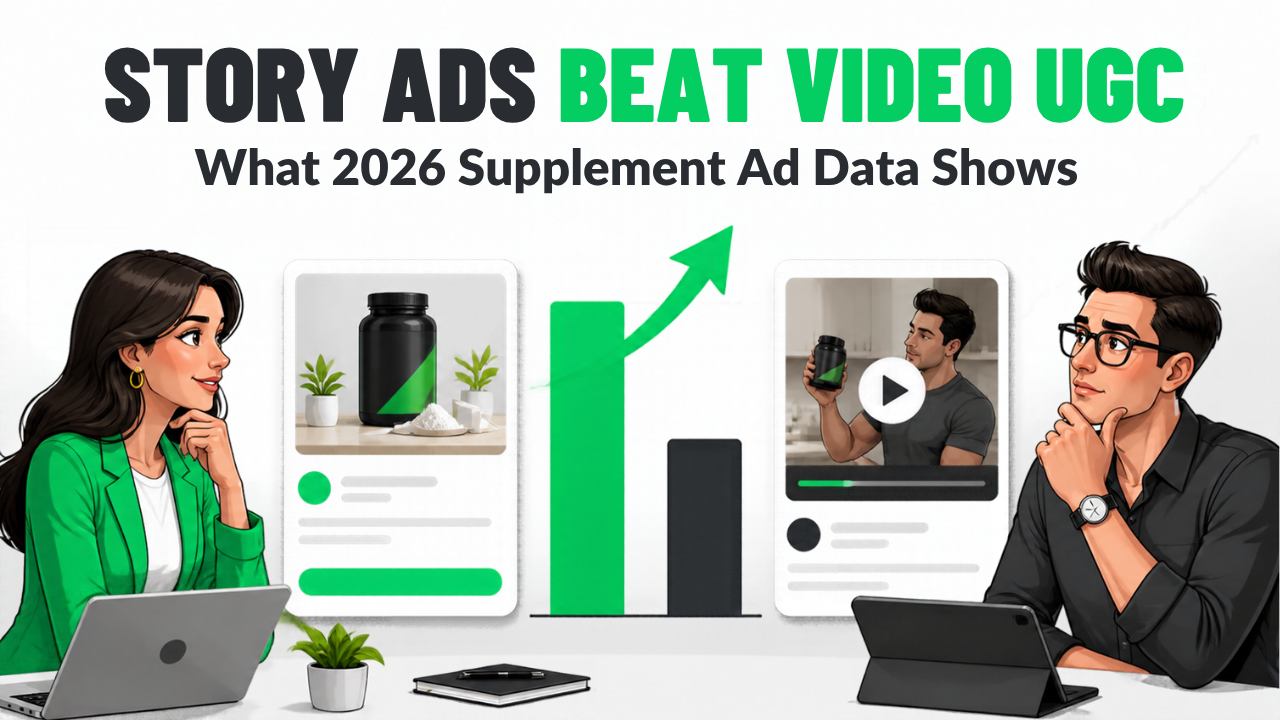
Why Story-Based Image Ads Are Outperforming Video UGC for Supplement Brands in 2026
By Firaas Dilawar, eBrandX · Published November 4, 2026 · 9 min read
Most supplement brands assume video UGC is the top-performing ad format in 2026. A fresh creative breakdown of 56 top-performing supplement ads on Meta says the opposite is happening right now.
Long-form, story-driven image ads are reportedly beating video UGC by a 4:1 ratio among the brands studied. If your 2026 creative budget is still mostly video, this is worth a hard look.
Key Takeaways
Story-format image ads (500 to 1,000 words of personal narrative plus one simple lifestyle photo) are reportedly outperforming video UGC among top supplement advertisers on Meta right now.
The winning hooks are behavior-based (a list, a permission filter, an agony opener), not outcome-based ("lose 10 lbs").
LEARN_MORE is reportedly beating SHOP_NOW as a call-to-action on story-format supplement ads.
This does not mean drop video UGC. It means most brands are under-testing image-and-copy formats and should rebalance their test budget before the format they already run gets more expensive.
What the 2026 Creative Breakdown Actually Found
A story-driven image ad is a long-form text post (roughly 500 to 1,000 words) built around a personal narrative, paired with one simple lifestyle photo instead of a video.
The analysis looked at 56 ads from recognizable supplement advertisers on Meta and scored them for performance. The pattern that stood out: the product almost never appears in the first few lines. The reader has to get emotionally invested first.
Three hook styles showed up again and again in the top performers:
- List hook: "4 reasons I drink this every morning" style openers.
- Permission filter: "Read this if you drink alcohol regularly" style openers that qualify the reader in or out.
- Agony opener: "I spent three years trying to calm my anxious mind" style openers that lead with a specific, lived struggle.
A fourth pattern, the anger hook (positioning conventional medicine or "big pharma" as the villain), showed up too, but it pulls in a skeptical audience that demands real substance behind the claim, so it is the riskiest of the four to run without a genuinely differentiated product story.
Two recurring narrative structures carried the winning ads: a doctor-authority structure (credentials, then validate the reader's frustration, then a contrarian insight, then the product as a discovery) and an agony-to-transformation structure (agony, discovery, transformation, invitation). Specific details ("three years," not "a long time") made the stories feel real.
Image Story Ads vs. Video UGC: The Side-by-Side
| Factor | Story Image Ad | Video UGC |
|---|---|---|
| Reported win rate (56-ad sample) | Roughly 4x | Baseline (1x) |
| Production cost per concept | Low (copy + one photo) | Higher (creator fee, filming, editing) |
| Typical test speed | Fast, 5 variations/day at low spend | Slower, new filming per variation |
| Best CTA in the sample | LEARN_MORE | SHOP_NOW |
| Scale example cited | AG1-style brand running ~500 live ads at once | Standard UGC rotation, shorter lifespan |
Source: APXlab creative analysis of 56 supplement ads on Meta, 2026. Figures are the source's reported findings, not an eBrandX client study; no sample methodology or confidence interval was published, so treat the 4:1 ratio as directional, not exact.
Why This Shift Is Happening Now
Three things are pushing image-and-story ads back into relevance.
First, video UGC saturation. Every supplement brand's feed looks the same: a creator talking to camera in a kitchen. Scroll-stopping has gotten harder, not easier.
Second, testing speed. A story-image ad can be written, laid out, and launched same-day. A video concept needs a creator, a shoot, and an edit before you even know if the angle works.
Third, Meta's algorithm rewards engagement time, and a genuinely engaging long-form story keeps a reader on the ad longer than a 15-second video they can skim past. Our own creative testing process (see how many new ads a supplement agency should actually launch each month) has been seeing the same pattern in client accounts over the last two quarters: image-plus-copy concepts are winning a growing share of the testing budget.
Fourth, platform economics are shifting at the same time. Amazon has started striking social-shopping deals with Meta and Snapchat, letting people buy Amazon listings without leaving those apps, largely to compete with TikTok Shop's growth. That means the line between "social content" and "shopping" is getting thinner everywhere, not just on TikTok. A supplement brand's Meta ad is increasingly also a shelf, and a shelf has to earn trust before it earns a click. A long, honest story does that better than ten seconds of someone holding a bottle.
What To Do, By Where Your Brand Is
Under $10k/month ad spend: Do not hire a creator this week. Write three story-image concepts yourself using the three hook styles above and test them at $20/day each before spending anything on video.
$10k to $50k/month: Split new creative tests roughly 50/50 between story-image and video UGC for one full testing cycle, then shift budget toward whichever format is actually winning in your account, not whichever format "feels" more professional.
$50k+/month: Build a standing story-image pipeline alongside your video pipeline. Treat copy testing as its own workstream, with its own weekly output target, not a side project for whoever has downtime.
Common Mistakes Brands Make With This Format
Mistake: Leading with the product in the first line.
Fix: Earn the read first. The best-performing ads introduce the product only after the reader is already emotionally invested in the story.
Mistake: Using an outcome-based hook ("lose weight fast") instead of a behavior-based one.
Fix: Open with a relatable behavior or moment (a list, a filter question, a specific struggle) and let the outcome show up later in the story.
Mistake: Treating the anger hook as a free win because it is attention-grabbing.
Fix: Only run an anger hook if your product genuinely has a contrarian, defensible angle. A weak anger hook with no real substance behind it gets picked apart in the comments and can trigger extra ad review scrutiny.
Mistake: Killing the format after one week because "it's just text."
Fix: Give any new creative format a full testing cycle (at least 5 to 7 days per concept at modest spend) before judging it, the same way you would a new video concept.
Mistake: Writing the story but skipping compliance review because "it's not a video with a visible claim."
Fix: Long-form copy ads still need the same structure/function claims review as video. See our breakdown of why winning supplement creative lasts longer for how compliant hooks can still be genuinely persuasive.
What This Means For Your Compliance Review
A long-form story ad is not a compliance shortcut. If anything, a 700-word story gives you more room to accidentally make an implied disease claim than a 15-second video does.
Every structure/function claim inside the narrative (energy, mood, sleep, focus, recovery) still needs to hold up the same way it would in a video script or a product label. The "contrarian insight" moment in the doctor-authority structure is usually where brands get into trouble, because it is tempting to overstate how much conventional advice is wrong in order to make the product feel like the obvious answer.
Run every new story concept through the same claims checklist you would use for video creative before it goes live, not after it starts spending. It is a five-minute check against a creative problem that can otherwise cost you the whole ad account.
FAQ
Should I stop running video UGC for my supplement brand?
No. The data suggests rebalancing your testing budget toward story-image ads, not abandoning video. Most accounts still need a mix of both.
What length should a story-image ad be?
Roughly 500 to 1,000 words based on the top performers studied, with one simple, non-stock lifestyle photo attached.
Which call-to-action button should I use on a story-format ad?
LEARN_MORE reportedly outperformed SHOP_NOW on story-format ads in the sample studied, likely because a long-form story primes curiosity rather than an immediate purchase decision.
Do I need a copywriter to run this format, or can my current team write it?
A strong story-image ad needs direct-response copywriting skill, not just good writing. If your team has not written compliant, hook-driven long-form ad copy before, this is usually worth outsourcing to a team that has.
How many variations should I test per hook style?
Roughly five variations per persona or hook style, each run at a modest daily budget, is a reasonable starting test structure before scaling the winners.
Does this creative shift apply to TikTok Shop too, or just Meta?
The 56-ad sample looked only at Meta. TikTok's format still leans heavily on short video, so treat this as a Meta-specific (and likely Facebook/Instagram feed) finding for now, not a universal rule across every platform you advertise on.
Bottom Line
Video UGC is not dead, but it is no longer the automatic default for supplement ad creative in 2026. Story-driven image ads are cheaper to produce, faster to test, and are reportedly winning a growing share of impressions among top performers.
The brands that win this quarter will be the ones testing both formats on purpose, not the ones defaulting to whatever they ran last year.
Want a creative testing plan built for your supplement brand, not a generic template?
Or join Supplements Scaling Insiders for templates, swipe files, and SOPs on creative testing like this.
Sources: APXlab Creative Lab, supplement ad creative analysis (2026). Today in Digital, Amazon social commerce coverage (2026).