

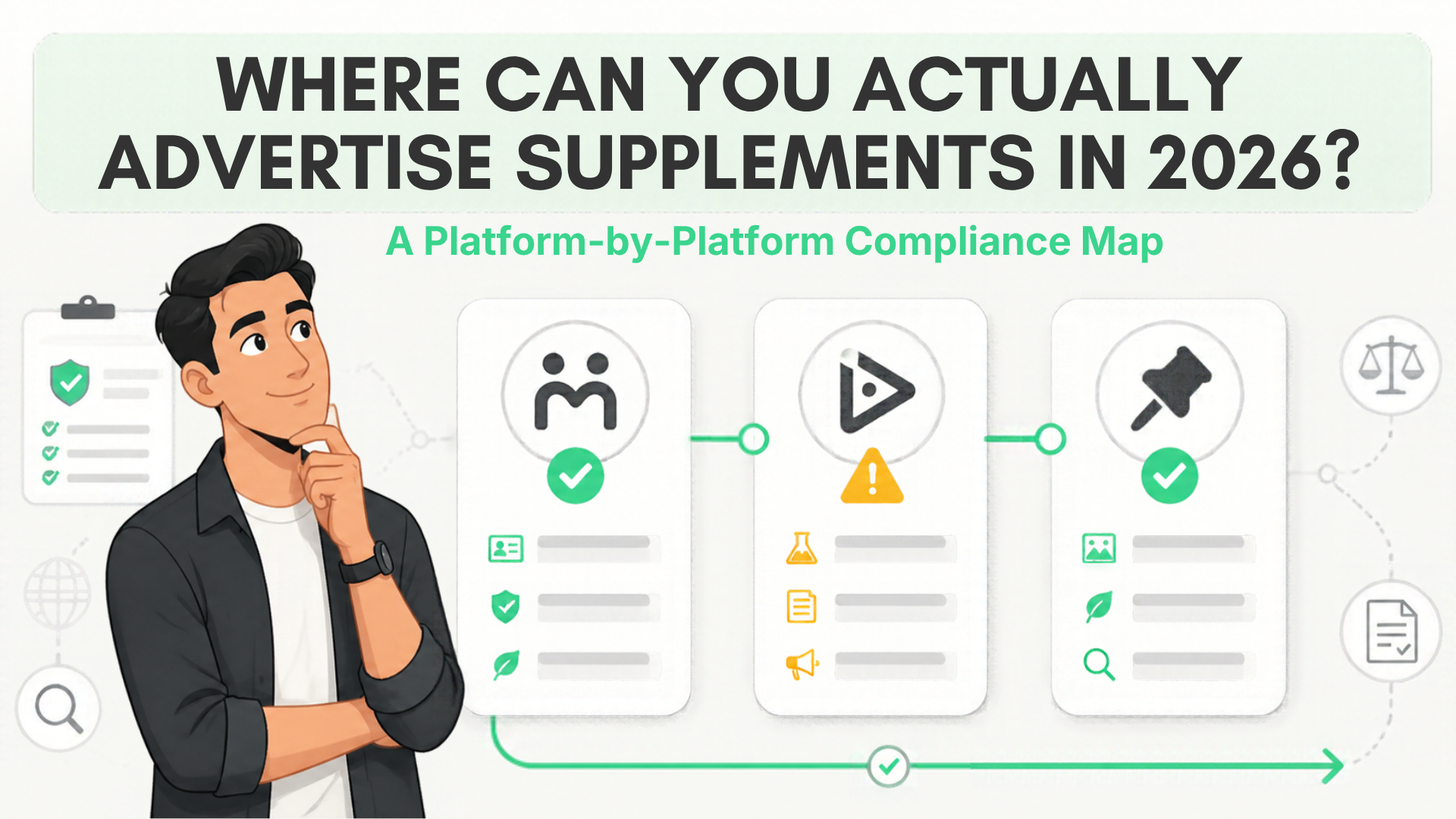
Where Can You Actually Advertise Supplements in 2026? A Platform-by-Platform Compliance Map
By Firaas Dilawar, eBrandX · Published November 5, 2026 · 8 min read
Your Meta ad gets approved. Your Pinterest ad for the same product gets rejected the next morning.
This happens constantly to supplement brands, and it is not random.
Every major ad platform writes its own supplement and health rules, and they do not match each other. Clearing one platform's review tells you almost nothing about the next.
Here is a real platform by platform map of what is allowed in 2026, so you stop losing budget to rejections and restrictions you could have seen coming.
Quick Look: What This Post Covers
Every major platform treats supplement and health ads differently, so a creative that is fine on TikTok can get your Meta account flagged for a completely different reason.
Meta requires 18+ targeting on supplement ads and blocks cure claims, but it does not ban weight management the way Pinterest and Snapchat do.
Pinterest and Snapchat ban before and after images outright, while Meta allows "manage symptoms" language that Pinterest will still reject.
Google, YouTube, and Microsoft run a separate certification system from the social platforms, so clearing one does not clear the others.
Why "Approved on One Platform" Means Nothing Everywhere Else
Each ad platform runs its own independent claims review for supplement and health content. There is no shared standard between them.
That means the same product image, the same claim, and the same audience targeting can be fine on one platform and a flagged account on another.
Most brands learn this the hard way, usually after an ad account gets restricted and they have to rebuild from scratch.
Knowing the differences up front is cheaper than fixing them after the fact.
The 2026 Platform Compliance Map
Here is what each major platform actually allows for supplement and health advertisers right now.
| Platform | Audience / Age Rule | Content Restrictions | Biggest Landmine |
|---|---|---|---|
| Meta (Facebook/Instagram) | Supplement ads must target 18+. Protein products are exempt. | No "cure" claims for incurable conditions. "Manage symptoms" language is allowed. Can't imply you know a user's health condition. | Custom and lookalike audiences built on sensitive health traits are disabled. |
| TikTok | Certain health-related ads must target 18+ in the US. Rules vary by country. | Advertisers are asked not to use TikTok's own tracking technology to collect healthcare information. | Country-by-country variation catches brands running the same campaign globally. |
| Can't target based on sensitive health or medical conditions. | Weight loss language and imagery banned outright (one exception: approved US/Canada healthcare advertisers for prescription GLP-1 meds). Before/after imagery and testimonials banned. | Manufacturers, pharmacies, and telehealth brands need prior platform permission. | |
| Snapchat | Health and dietary supplement advertisers need pre-approval before running any ad. | No weight-loss before/after images for supplements. Diet and fitness ads can't use before/after images or exaggerated claims at all. | Skipping pre-approval is an instant rejection, not a review delay. |
| X (Twitter) | Custom audiences and conversion events based on sensitive information, including health data, are prohibited. | Health and pharmaceutical promotion is banned by default. Listed exceptions (telemedicine, pharmacies, FDA-approved devices) do not mention supplements. | Assuming supplements qualify for an exception that was written for a different category. |
| Reserves broad authority to restrict advertising tied to any health matter. | Ads can't idealize or criticize physical attributes. | The Insight Tag is blocked on healthcare-related domains. Use Conversions API or first-party CRM audiences instead. | |
| Google / YouTube / Microsoft | Runs on a separate certification system from the social platforms. | Certification approved on one of these platforms must still be presented separately on each other. | Treating one search-ads certification as if it covers all three. |
Source: Accelerated Digital Media, "2026 Health Advertising Policies on Social Media" (published August 27, 2026). Platform policies change often. Confirm current terms directly with each platform before launching.
"Clearing Meta's review tells you almost nothing about whether Pinterest, Snapchat, or X will approve the exact same creative."
Where to Put Your Budget, By Situation
The right platform mix depends on your product and your history, not a generic "best channels" list.
Match Your Situation to a Starting Point
New brand, no restricted accounts yet: Start on Meta and Google/YouTube. Both support supplement advertising, but each needs its own claims review before launch.
Already restricted once on Meta: Diversify into TikTok and Pinterest in parallel, so one account issue does not take down all of your paid revenue at once.
Running UGC creators or affiliates: Treat each platform's disclosure and claims rules as a creator onboarding requirement, not just a brand-side checklist.
Weight management specific product: Pinterest and Snapchat ban weight loss content outright. Put that budget on Meta (with careful claims review) and Google/YouTube instead.
Common Mistakes Brands Make Across Platforms
Mistake: Treating "approved on Meta" as "approved everywhere."
Each platform runs claims review independently. A creative cleared on Meta can get disapproved, or get your account flagged, on Pinterest or Snapchat for the exact same image.
Mistake: Letting affiliates and creators post with no claims review.
Unverified health claims from creators are a live enforcement target right now, not a theoretical risk.
Mistake: Using identical tracking setups across every platform.
LinkedIn blocks its Insight Tag on healthcare domains. TikTok asks advertisers not to collect healthcare data through its tracking tools. One tracking setup can quietly violate two platforms at once.
Mistake: Treating every SKU the same way.
Meta exempts protein products from its 18+ targeting rule, but not other supplements. Lumping every product into one campaign structure can misapply age-gating across your whole catalog.
A 5-Point Checklist Before You Launch on a New Platform
Run through this before you move budget to a platform your brand has not advertised on before.
- Pull that specific platform's current health and supplement ad policy. Do not reuse what you confirmed six months ago.
- Check whether the platform requires pre-approval (like Snapchat) before your first ad can even go live.
- Review every image in your ad set for before/after framing, even implied before/after, since Pinterest and Snapchat reject this outright.
- Confirm your tracking setup does not collect or imply health data in a way that platform restricts (LinkedIn's Insight Tag and TikTok's tracking rules are the two most commonly missed).
- Get a second read on your claims language from someone outside the person who wrote the ad copy. A fresh set of eyes catches what the writer cannot see anymore.
This is close to the exact process eBrandX runs with new clients before their first dollar goes live on a platform, outlined in more detail in our first-call compliance audit breakdown.
Why the Rules Diverged This Much
It is tempting to assume every platform copied the same baseline health ad policy and just tweaked it slightly. That is not what happened.
Each platform built its rules around its own biggest risk. Pinterest leans visual and discovery-based, so it clamped down hardest on before/after imagery.
Meta leans on detailed targeting, so its biggest changes landed on audience and tracking restrictions, not just creative review.
LinkedIn and X mostly treat health advertising as a smaller, lower-priority category, which is why their rules read broader and vaguer instead of being spelled out claim by claim. Vague is not the same as permissive, though. It usually means more manual review, not less.
Frequently Asked Questions
Can I run the same ad creative across Meta, TikTok, and Pinterest?
Not safely. Each platform has its own claims and imagery rules, and Pinterest and Snapchat ban before and after images that Meta may allow depending on the exact claim.
Does TikTok ban supplement ads?
No. But certain health-related ads must target users 18+ in the US, and TikTok asks advertisers not to use its own tracking technology to collect healthcare information.
Which platform is strictest for weight management supplements?
Pinterest and Snapchat. Both ban weight loss imagery and before/after content outright, with only a narrow Pinterest exception for approved prescription GLP-1 advertisers.
Do I need separate certifications for Google, YouTube, and Microsoft Ads?
Yes. These run on a separate rule set from the social platforms, and certification recognized on one must still be presented separately on each.
What is the blind spot most brands miss?
Tracking and audience targeting, not just ad copy. Several platforms now restrict custom audiences, lookalikes, or tracking tags tied to health conditions, a newer change that gets far less attention than claims language.
Bottom Line
There is no single supplement ad rulebook in 2026. There are seven different ones, and they do not agree with each other.
The brands that scale smoothly are not the ones with the cleverest creative. They are the ones who check platform rules before launch instead of after a rejection or a restricted account.
If you want a second set of eyes on your account before you scale spend across new platforms, that is exactly what eBrandX's compliance audit process is built to catch.
Want a platform-by-platform compliance check before you scale?
Book a Free Strategy CallWant more of this kind of breakdown as it happens? Join Supplements Scaling Insiders, our community for supplement brand owners.
Sources: Accelerated Digital Media, "2026 Health Advertising Policies on Social Media" (August 27, 2026).