


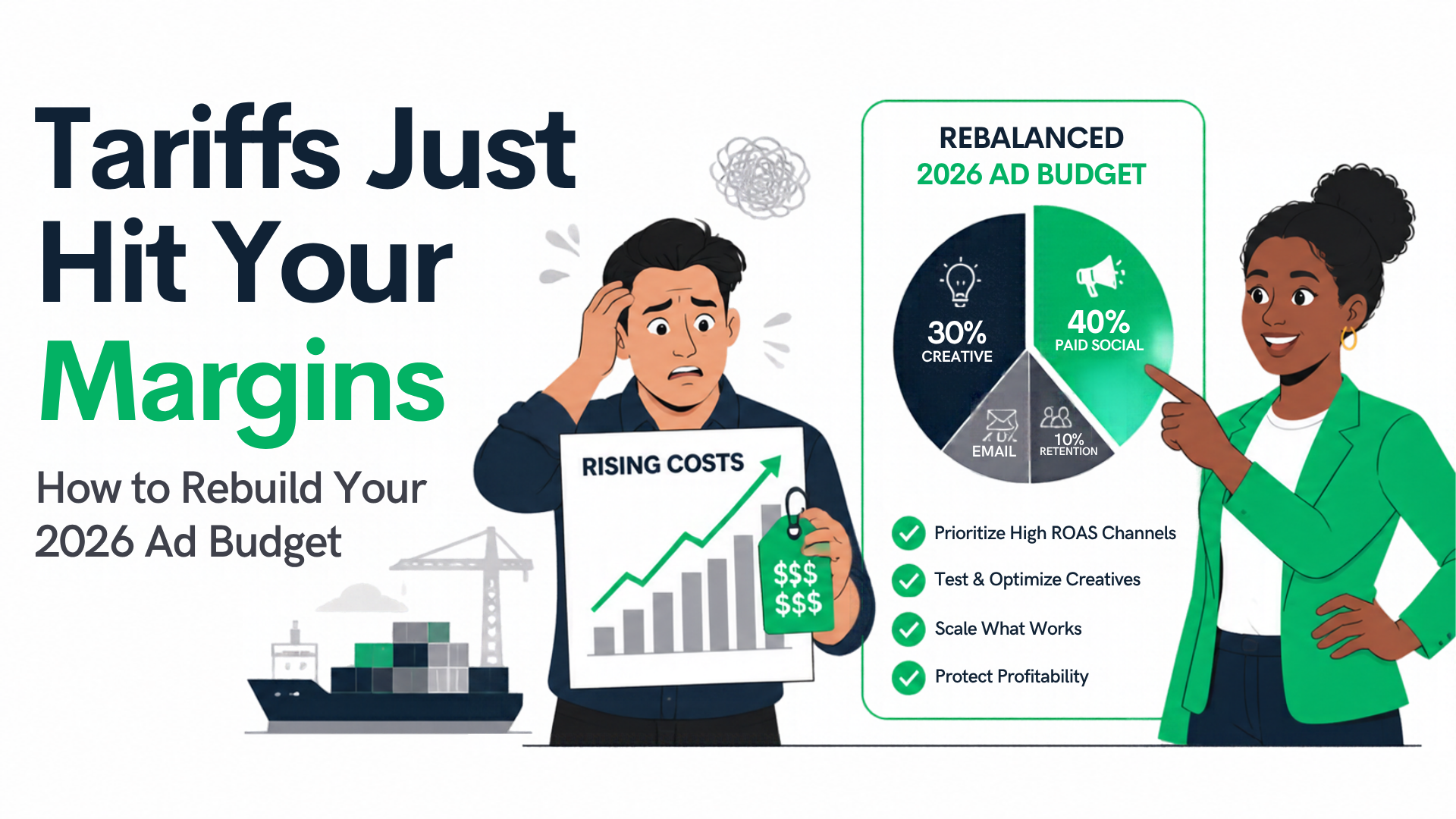
Tariffs Just Hit Your Margins: How to Rebuild Your Supplement Brand's 2026 Ad Budget
Your supplement brand's cost to make product just went up.
Maybe 15%. Maybe 25%.
That is not a marketing problem. But it is about to become one.
When your landed cost jumps, your ad budget has to work differently.
The brands handling 2026's tariff shock well are not the ones with the biggest budgets. They are the ones who moved their spend first.
Quick Look
Supply chain data from DTC brands shows three ways companies are reacting to 2026 tariffs: absorbing the cost, passing it to customers, or pivoting their sourcing and ad spend together.
The pivoters are the ones still growing by month six.
This post breaks down the real cost increases, the budget reallocation model that is working, and how to know if your supplement brand's current agency is even watching this.
What Tariffs Are Actually Doing to Supplement Brand Costs
Supply chain data pulled across dozens of DTC brands shows import costs rising 15 to 20% on food and supplement products alone in 2026. Other consumer categories are seeing even bigger jumps.
| Category | Average Import Cost Increase |
|---|---|
| Food & Supplements | 15% to 20% |
| Beauty & Personal Care | 18% to 25% |
| Pet Products | 22% to 28% |
| CPG & Household | 20% to 30% |
Figures are directional, drawn from one growth agency's reported work across 200+ DTC brands (ATTN Agency, March 2026). Treat them as a planning signal, not an audited study.
A 15 to 20% cost jump sounds survivable on paper. It is not survivable if your ad spend keeps running on last year's assumptions.
Three Ways Supplement Brands Are Reacting (Only One Is Working)
The same data splits brand responses into three camps.
- Absorbers (about 15% of brands). They hold prices and eat the margin hit. This works for under six months before cash flow problems start.
- Passers (about 60% of brands). They raise prices and hope customers do not notice. Some do not. A lot do.
- Pivoters (about 25% of brands). They restructure sourcing, trim weak SKUs, and move ad dollars to match the new math.
"The Pivoters consistently outperform the other two models by month six."
Pivoting is not just a supply chain decision. It is a marketing decision too.
Brands making this shift are cutting 30 to 40% of low-margin SKUs and pushing spend toward the products that still convert at the new cost basis. Reported blended ROAS gains from that shift run 25 to 35%.
That is the real opportunity hiding inside a bad situation. If you want the broader picture on what good ROAS actually looks like for your sub-category right now, our CAC and ROAS benchmarks guide is the companion piece to this one.
The Ad Budget Model Brands Are Shifting To
Once a brand's unit economics move by 20% or more, the agencies handling this well stop running the old media mix. They rebuild it around four buckets.
| Budget Bucket | % of Spend | Channels |
|---|---|---|
| Efficiency First | 40% to 50% | Google Shopping, email/SMS, organic, referrals |
| Brand Building | 20% to 30% | Connected TV, YouTube, podcasts |
| Testing | 15% to 20% | TikTok, Reddit, influencer |
| Emergency Reserve | 10% to 15% | Held back for supply shocks and clearance pushes |
Notice what is missing from most brands' current spend: a reserve line.
Most supplement brands run every dollar every month. That is fine in a stable year, but not in a year where your supplier's price can change twice before Q4.
If your current ad spend has never been stress-tested against a scenario like this, that is worth a real look. Our ad spend benchmark guide is a good starting point for seeing where your numbers actually sit.
Where Pivoting Brands Are Sourcing Instead
Reallocating ad spend only helps if the supply side moves too. Brands making the pivot are not just cutting SKUs, they are also shifting production away from their old supplier base.
| Sourcing Region | Unit Cost vs. China | Net Landed-Cost Effect |
|---|---|---|
| Mexico | +12% to 18% | 7% to 12% net savings, 3 to 4 weeks faster |
| Eastern Europe | +15% to 22% | Minimum order sizes 20% to 30% lower |
| Vietnam / Thailand | +8% to 15% | Smallest cost jump of the three options |
The pattern across all three options is the same. Moving earlier costs less than moving late.
Brands that waited until a warning letter or a cash crunch forced the decision paid more for the same move, on a worse timeline.
Forecasts for the second half of 2026 point the same direction for most of this market: nearshoring becomes the default rather than the exception, Connected TV budgets from DTC brands climb 40% or more, and subscription or bundle offers get pulled forward to protect average order value against rising unit costs.
Quick Answers
Do tariffs actually affect supplement brands, or mostly bigger CPG categories?
Food and supplement imports are seeing 15 to 20% average cost increases in 2026, lower than beauty or pet categories but still high enough to change unit economics for most brands running on thin margins.
Should I cut my ad budget if costs go up?
Not across the board. The brands outperforming are the ones that reallocate spend toward efficiency channels and protect retention, not the ones that shrink their whole budget evenly.
How fast should a supplement brand respond to a tariff-driven cost increase?
As soon as the new landed cost is confirmed. Every month of delay tends to show up later as a bigger, more disruptive fix instead of a planned one.
Retention Gets More Valuable, Not Less
Here is the part most brands miss when costs rise. They cut retention spend to protect acquisition spend.
That is backwards.
When acquisition costs climb 25%, every existing customer becomes 25% more valuable simply because replacing them costs more. Brands handling this well are doing the opposite of cutting: they are extending their flows.
- Welcome series stretched from 7 emails to 12
- Post-purchase flows stretched from 4 emails to 8
- Win-back flows stretched from 3 emails to 6
None of that costs new ad dollars. It is a sequencing fix, and it is one of the cheapest margin-protection moves available right now.
Is Your Agency Even Watching This?
A lot of supplement brands are still being run on last year's media plan by an agency that has not mentioned tariffs, landed cost, or SKU rationalization once this year.
That silence is the real red flag. If your supplement brand's cost structure shifted and your weekly report still looks identical to January, nobody is actually managing the account against reality.
5-Point Tariff-Proofing Checklist
- Know your landed cost change by SKU, not just by category average.
- Cut or deprioritize the SKUs under 5% revenue contribution before you cut ad spend anywhere else.
- Rebuild your media mix around the four-bucket model above, including a real emergency reserve.
- Extend your email and SMS retention flows instead of shrinking them.
- Ask your agency directly how your plan has changed because of 2026 cost increases. If the answer is vague, that is your answer.
This is exactly the kind of structural shift eBrandX walks supplement brands through across Amazon, Meta, and TikTok Shop, not just a creative refresh but a real look at where the budget needs to move. If you want a second set of eyes on your current media mix against this new cost reality, book a free strategy call and we will walk through it together.
We also covered how holiday-week CPM spikes compound this exact problem in our Black Friday 2026 ad budget breakdown, which pairs well with the reallocation model above if Q4 is already on your mind.
Want the templates, swipe files, and SOPs other supplement brand owners are using to navigate 2026? Our Supplements Scaling Insiders community is built exactly for moments like this one.
The Bottom Line
Tariffs are not a reason to panic. They are a reason to move first.
The brands absorbing the hit quietly will run out of runway. The brands just raising prices will lose customers who notice.
The brands rebuilding their budget, trimming weak SKUs, and protecting retention are the ones still growing by the second half of the year.
Which camp is your supplement brand actually in right now? If you are not sure, that is usually the clearest sign it is time for a second opinion.