

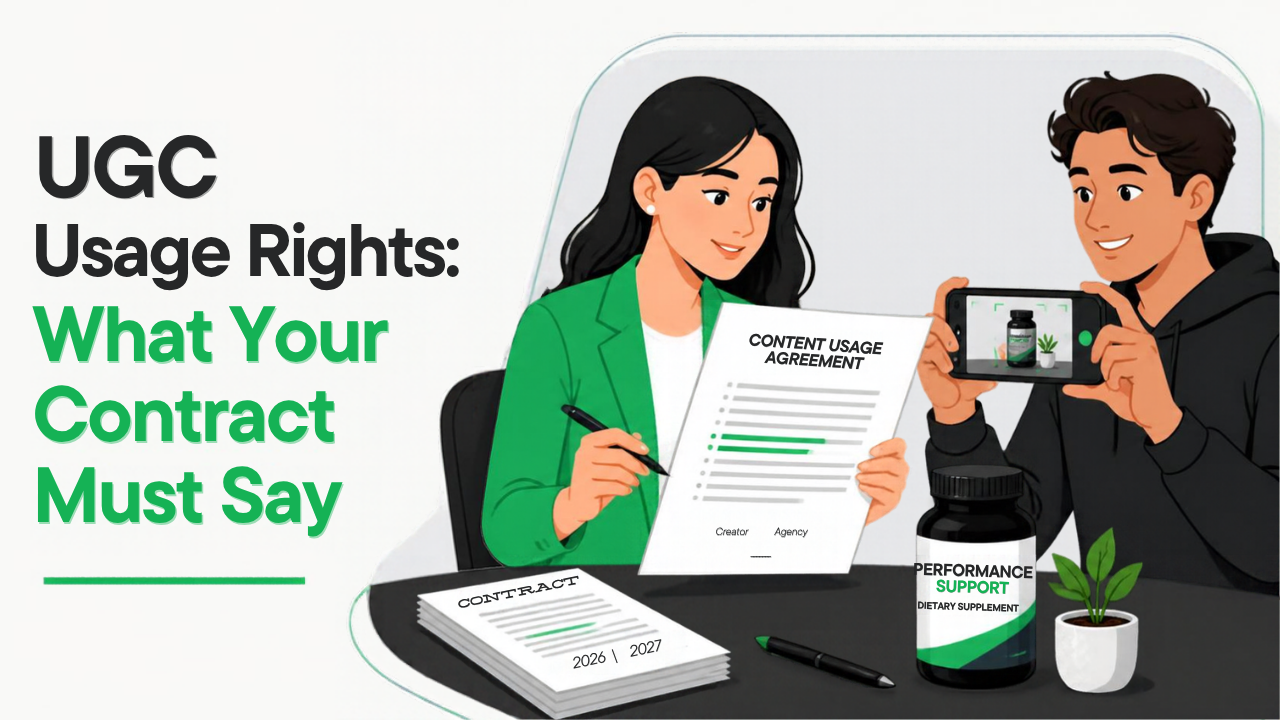
UGC Usage Rights for Supplement Brands: What Your Creator Contracts Should Actually Say
You finally got a creator to send back a great UGC video for your supplement brand.
The hook is strong. The product looks good on camera. Your ad buyer is ready to push spend behind it today.
Then someone asks a simple question: "Can we actually run this as a paid ad, or did we only pay for an organic post?"
If nobody can answer that fast, you don't have a creative problem. You have a usage rights problem, and it is one of the most common (and most avoidable) ways supplement brands lose money on content they already paid for.
Quick Look
The problem: Most UGC deals are handshake agreements with no clear usage terms.
The risk: Content gets pulled, licenses expire, or ads get flagged mid-flight.
The fix: Every creator contract should spell out platform, duration, and buyout terms before filming starts.
Who this is for: Supplement brands running (or planning to run) paid UGC ads on Meta, TikTok, or TikTok Shop.
Why Usage Rights Became a Bigger Deal in 2026
UGC is not a side tactic anymore. It is the format most supplement brands lean on for cold-traffic ads.
That shift means brands are working with more creators, more often, often through quick DMs or a single group chat message.
Speed is good. But speed without a written usage agreement is how brands end up with content they cannot legally (or safely) keep running.
We covered the difference between a UGC-only agency and a full-service ad agency in an earlier post. Usage rights are exactly the kind of detail that gets missed when a brand is only buying raw footage and handling the rest themselves.
"A creator contract isn't paperwork. It's the thing that decides whether your best-performing ad is still legal to run next week."
The Four Usage Models You'll Run Into
Not every UGC deal means the same thing. Always confirm which of these four models you're actually buying before you pay a creator, because the price difference is huge and the rules are different for each one.
| Usage Model | What It Covers | Typical Term |
|---|---|---|
| Organic Only | Creator posts to their own page. Brand cannot run paid ads with it. | N/A (creator owns it) |
| Whitelisting / Spark Ads | Brand runs ads through the creator's own handle, boosting their post. | Usually 30 to 90 days |
| Paid Usage License | Brand can run the raw file as a dark post ad from its own account. | Set term, often 3 to 12 months |
| Full Buyout | Brand owns the content outright, including edits and repurposing. | Unlimited / perpetual |
Here's an illustrative example, not a real client case: a brand pays a creator $150 for "a video," assumes that covers paid ads, and finds out three weeks into a winning campaign that the license only covered a 30-day whitelisting window. The ad gets pulled mid-scale, right when it was finally profitable.
Five Things Every UGC Contract Should Spell Out
Before a single dollar changes hands, get these five details in writing.
- Platforms covered. Meta, TikTok, TikTok Shop, YouTube, and your own website are not automatically bundled together.
- Usage duration. A fixed end date, or "perpetual" if you're buying full rights.
- Paid vs. organic use. State clearly whether this covers boosted or dark-post ads, not just the creator's own feed.
- Editing rights. Can your team cut, caption, remix, or combine this footage with other clips?
- Exclusivity. Is this creator free to make the same style of video for a competing supplement brand next week?
Watch for this: If a contract never mentions an end date, don't assume that means forever. In most jurisdictions, unclear usage terms default in the creator's favor, not the brand's.
The Disclosure Rule Most Contracts Forget
Usage rights cover whether you can run the ad. Disclosure rules cover how you have to run it.
In the United States, the FTC requires a clear, visible disclosure (like "#ad" or "Paid Partnership") any time a creator is compensated for talking about your product, paid ad or not.
Supplement brands carry extra risk here, because an undisclosed partnership combined with an aggressive health claim is the kind of thing that draws regulatory attention fast.
Your creator contract should require the disclosure language up front, not leave it as an afterthought the creator may or may not remember. We walk through the broader claims side of this in our compliance audit breakdown, which is the same lens we use when reviewing a brand's UGC before it goes live.
Auditing the UGC You're Already Running
Most brands don't start from zero. They already have a library of creator content, some of it with a contract, some of it from a DM conversation six months ago.
Before you add anything new, it's worth auditing what's already live. Here's a simple way to work through it.
- Pull every active ad that uses creator-filmed content, across every platform you advertise on.
- Match each video to a contract or paid invoice. No paper trail means no confirmed usage rights, even if the creator never complained.
- Check the dates. Flag anything running past a license's expiration, or anything with no expiration listed at all.
- Confirm the disclosure is visible in the ad itself, not just mentioned once in a group chat.
- Fix the gaps before you scale spend on that creative, not after.
This kind of audit takes an afternoon. Skipping it is how brands end up rebuilding a top-performing ad from scratch because the original license quietly expired.
Why This Gets Messy Fast at Scale
One creator deal is easy to track in your head.
Twenty creator deals a month, each with a different start date and expiration, is not.
This is exactly the kind of thing that should show up in your weekly ad agency report: which creative is still inside its usage window, and which is about to expire before you've even finished scaling it.
We also outlined how to protect your ad account ownership in a separate post. Creative rights and account ownership are two different risks, but they both come down to the same habit: get it in writing, early, before you're relying on the asset to hit a revenue number.
How We Handle This for eBrandX Clients
We build usage rights into the creator brief before filming even starts, not after we see which video wins.
That means every piece of UGC we source or script for a client comes with a clear, written license covering platform, duration, and paid usage from day one.
If you want a second set of eyes on the UGC and creative contracts you're already running, or you're building out a supplement brand's paid UGC engine from scratch, that's exactly the kind of gap we close for clients inside eBrandX.
Not sure your current UGC contracts actually protect your ad spend?
Book a free call and we'll walk through what your creator agreements should cover.
Book Your Free CallQuick Answers
Does a verbal agreement with a creator count as a usage license?
It can hold up in some cases, but it's hard to prove and easy to dispute. Get the terms in writing, even if it's just a short email confirming price, platform, and duration.
What happens if we keep running an ad after the usage license expires?
The creator can ask the platform to remove it, send a legal notice, or simply stop working with your brand again. None of those are worth the saved ten minutes of paperwork.
Is a full buyout always the better option?
Not always. A full buyout costs more upfront. If you only need 60 days of paid testing on one angle, a time-limited license is often the smarter spend.
The Bottom Line
A winning UGC ad is only as useful as the paperwork behind it.
Lock down platform, duration, paid usage, editing rights, and exclusivity before you film, not after your ad starts spending.
It is a five-minute conversation that can save a campaign (and a budget) weeks later.
Want templates, swipe files, and real creator-contract examples other supplement brand owners are using right now? Our Supplements Scaling Insiders community covers exactly this kind of operational detail.