


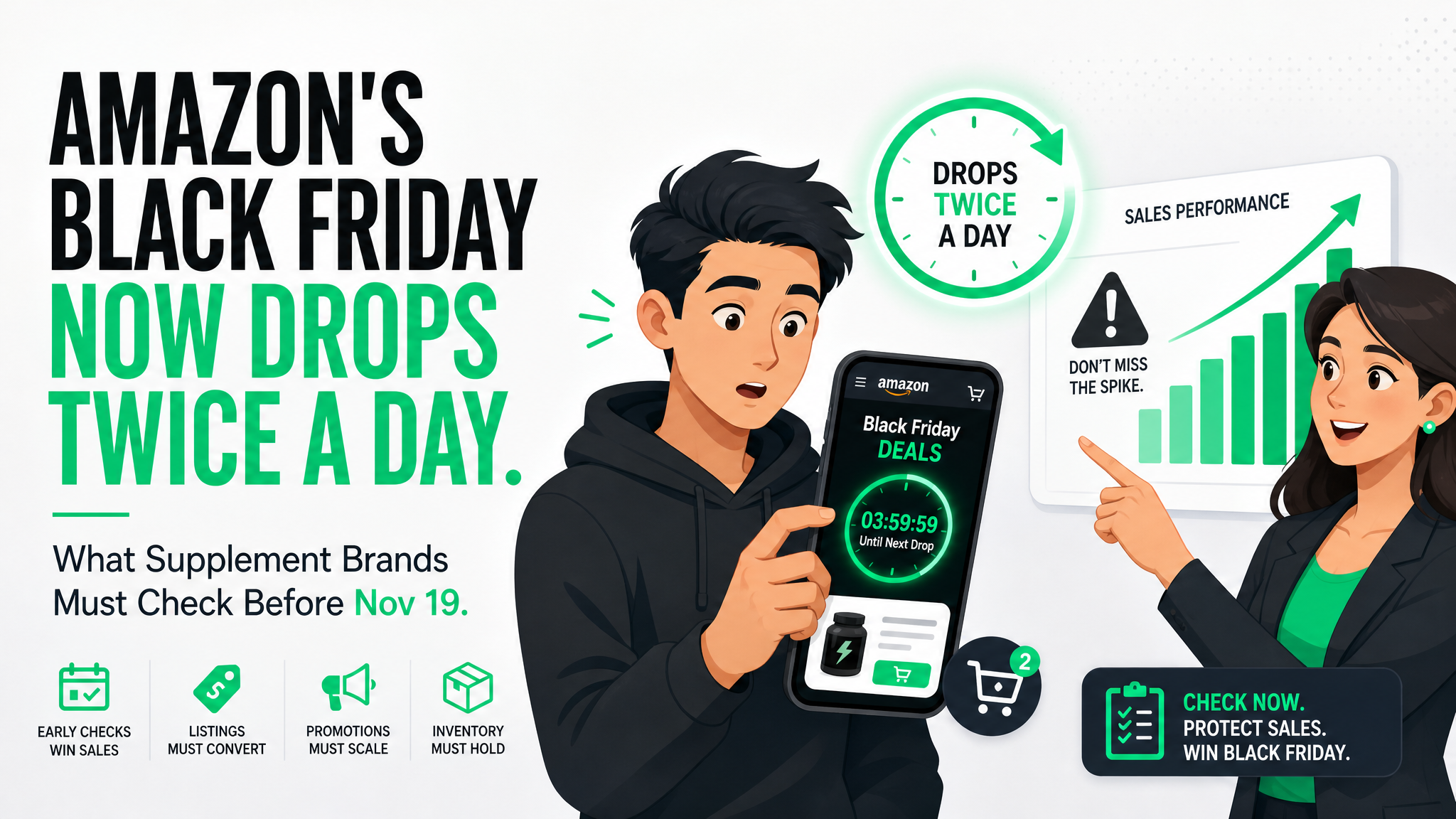
Amazon's Black Friday Week 2026: Twice-Daily Deal Drops and AI Auto-Buy, What Supplement Brands Must Check Before Nov 19
By Firaas Dilawar, eBrandX · Published November 17, 2026 · 7 min read
Amazon just announced its Black Friday Week dates for 2026. The event runs November 19 to November 30, and for the first time, deals will drop twice a day on the two biggest days.
There is also a quieter change buried in the same announcement. Amazon's shopping assistant can now finish a purchase on its own once a price hits a shopper's target.
For a supplement brand, that is not a footnote. It changes where your ad budget needs to sit in the next two weeks. Here is what actually changed, and the checklist to run before November 19.
Key Takeaways
Black Friday Week 2026 runs November 19 to 30, with deals dropping twice a day (midnight and 8 a.m. Pacific) on Black Friday and Cyber Monday, a first for Amazon.
Amazon's Alexa for Shopping assistant has an Auto-Buy feature that completes a purchase the moment a tracked price meets a shopper's target, with no click required.
Amazon's AI assistant narrows a typical search from about 50 products down to roughly 5, and sponsored prompts inside that assistant have been billable since March 2026.
Deal terms you submitted in October are locked in, but PPC pacing, buy box health, and inventory buffers for the two daily drop windows are still fully in your hands through November 19.
What Actually Changed for Black Friday Week 2026
Amazon's Black Friday Week and Cyber Monday event is a 12 day window, running from Thursday, November 19 through Cyber Monday, November 30, 2026. Black Friday itself lands on November 27.
The event is built around six recurring deal themes: Toys, Tech, Fashion, Beauty, Premium Gifts, and Stocking Stuffers. Amazon says savings on Black Friday and Cyber Monday can reach up to 60% on select items.
The real change is timing. On Black Friday and Cyber Monday only, new deals will drop twice, at midnight and again at 8 a.m. Pacific time. Amazon has never split a peak day into two drops before. In 2024 and 2025, each peak day got one drop.
For third party sellers, most of the groundwork is already done. The deal submission window closed back on October 20, 2026, and peak fulfillment fees have been in effect since October 15, running through January 14, 2027. Any item bought between November 1 and December 31 can also now be returned through January 31, 2027, which is a standing annual policy Amazon confirmed this fall.
The AI Layer: Auto-Buy, Price Tracking, and a Narrower Shelf
Amazon merged its Rufus shopping AI with Alexa+ earlier in 2026 into a single assistant called Alexa for Shopping. Amazon says more than 400 million customers used it in the past 12 months, and that US shoppers who use it spend 50% more per order than those who don't.
Two features inside it matter directly for the next two weeks.
Auto-Buy. A shopper can ask the assistant to watch a product's price. The moment it drops to the shopper's target, Auto-Buy completes the purchase for them, without the shopper coming back to the page to click anything. Amazon's announcement does not say whether an Auto-Buy order can be canceled once it fires, or what happens if the item is a limited quantity deal that sells out between the midnight and 8 a.m. drops.
A narrower shelf. Independent research from Workflow Labs, cited in Amazon's own trade coverage, found that Rufus style AI search narrows a typical result set from around 50 products down to about 5 named products. We covered what that means for listing visibility in our Rufus Readiness Audit. Sponsored Products and Sponsored Brands prompts shown inside the assistant have been billable under normal cost per click bidding since March 25, 2026, so paid placement inside the AI layer is now a real budget line, not a future maybe.
Why This Matters More for Supplement Brands
More than 60% of Amazon's sales come from independent sellers, most of them small and medium sized businesses, and supplement brands are a large share of that group. A narrower AI shelf and a price triggered auto purchase both reward the listing that is ready the moment the clock hits midnight or 8 a.m., not the listing that gets fixed a day later.
Stockouts are the clearest risk. If your inventory buffer runs out between the midnight drop and the 8 a.m. drop on Black Friday or Cyber Monday, an Auto-Buy shopper who was tracking your price can simply get routed to a competitor's listing instead, with no ad click or search involved at all.
"Twice daily drops on the two peak days give shoppers, and their assistants, more moments to act." That is the real shift behind this year's announcement: the moment of purchase has multiplied, and it increasingly happens without a seller watching.
2026 Benchmark Numbers to Plan Your Budget Around
Here is how this year's event compares to the last two, plus the spend and cost data worth building a budget around.
| Year | Event Window | Black Friday | Cyber Monday | Peak Day Deal Drops |
|---|---|---|---|---|
| 2024 | Nov 21 to Dec 2 | Nov 29 | Dec 2 | One per day |
| 2025 | Nov 20 to Dec 1 | Nov 28 | Dec 1 | One per day |
| 2026 | Nov 19 to Nov 30 | Nov 27 | Nov 30 | Two (midnight + 8am PT) |
Methodology: event dates and deal drop structure from Amazon's official Black Friday Week announcements, reported by PPC Land (November 12, 2026). Thanksgiving falls one day earlier each year in this cycle, which shifts the whole window.
| Metric | 2026 / 2025 Figure |
|---|---|
| Forecast US online spend, Black Friday 2026 | $12.9 billion |
| Forecast US online spend, Cyber Monday 2026 | $15.1 billion |
| Forecast total US online holiday spend, Nov to Dec 2026 | $275.1 billion (up 6.7%) |
| Cost per order change, Black Friday week 2025 | Down 18% versus the prior week |
| Amazon ad revenue, Q3 2026 | $19.64 billion, up 11%, with "high teens" growth guided for Q4 |
Sources: Adobe Analytics holiday forecast and Billy Grace cost per order analysis, both reported by PPC Land; Amazon third quarter 2026 earnings call. See full source list at the end of this post.
What to Prioritize, by Spend Level
Under $10K a month in ad spend: focus on inventory buffers and buy box health for November 27 and 30. Don't chase Sponsored Display increases you can't support with stock.
$10K to $50K a month: shift Sponsored Products bids higher specifically around the two drop windows (roughly 12 to 2 a.m. and 8 to 10 a.m. Pacific) on November 27 and 30, rather than raising budgets evenly across the whole day.
$50K+ a month: layer in Sponsored Brands and review post-event performance with Amazon Marketing Cloud, which is now free for every Sponsored Ads advertiser. We cover that setup in our Amazon Marketing Cloud guide.
Common Mistakes to Avoid This Week
Mistake: "We already locked in our Black Friday deal in October, so we're done."
Reality: the deal terms are locked, but PPC bid pacing, buy box monitoring, and inventory buffers for the two drop windows are still entirely in your control through November 19.
Mistake: assuming Auto-Buy only matters for large, well known brands.
Reality: Auto-Buy triggers on a price threshold, not a brand name. Any supplement listing with a tracked price can be bought automatically, and any listing that goes out of stock at the wrong moment can lose that sale to a competitor instead.
Mistake: raising ad budgets evenly across all of Black Friday and Cyber Monday.
Reality: with two separate deal drops and an AI layer that narrows the shelf to roughly 5 products at a time, competition concentrates hard around each drop window. Flat, all day budget increases waste spend during the quieter hours.
FAQ
When does Amazon's Black Friday Week 2026 run?
November 19 through November 30, 2026, with Black Friday on November 27 and Cyber Monday on November 30.
What's different about deal drops this year?
For the first time, new deals drop twice on Black Friday and Cyber Monday: once at midnight Pacific and again at 8 a.m. Pacific.
What is Auto-Buy, and does it affect smaller supplement sellers?
Auto-Buy is a feature inside Amazon's Alexa for Shopping assistant that completes a purchase automatically once a tracked price hits a shopper's target. It applies to any listing with a watched price, regardless of brand size.
I missed the October 20 deal submission deadline. Can I still do anything?
The official deal submission window is closed, but you can still adjust PPC budgets and bid pacing, shore up inventory buffers, and monitor buy box health ahead of November 19.
Are sponsored ads shown inside Amazon's AI assistant?
Yes. Sponsored Products and Sponsored Brands prompts inside the assistant have been billable under standard cost per click bidding since March 25, 2026.
Bottom Line
Amazon's Black Friday Week 2026 is longer in structure but tighter in timing. The two daily deal drops on November 27 and 30, combined with an AI assistant that can buy on a shopper's behalf and show only about 5 products at a time, mean the window for a supplement listing to be ready is narrower than ever.
The brands that do well this year will be the ones who treat the next two weeks as a readiness sprint, not a budget they already locked in back in October.
Want a second set of eyes on your Black Friday PPC pacing and inventory buffers before November 19?
Book a Free Strategy CallPrefer to learn with other supplement brand owners first? Join our Supplements Scaling Insiders community for templates, swipe files, and peer support.
Sources: PPC Land, "Amazon's Black Friday Week runs Nov 19-30 with 12 days of deal drops" (November 12, 2026); PPC Land, "Adobe puts US online holiday spend at $275.1 billion, up 6.7%"; PPC Land, "Cost per order drops 18% in 2025 Black Friday week, Billy Grace finds"; PPC Land, "Amazon ad revenue growth drops to 11% after Prime Day moves to June."