


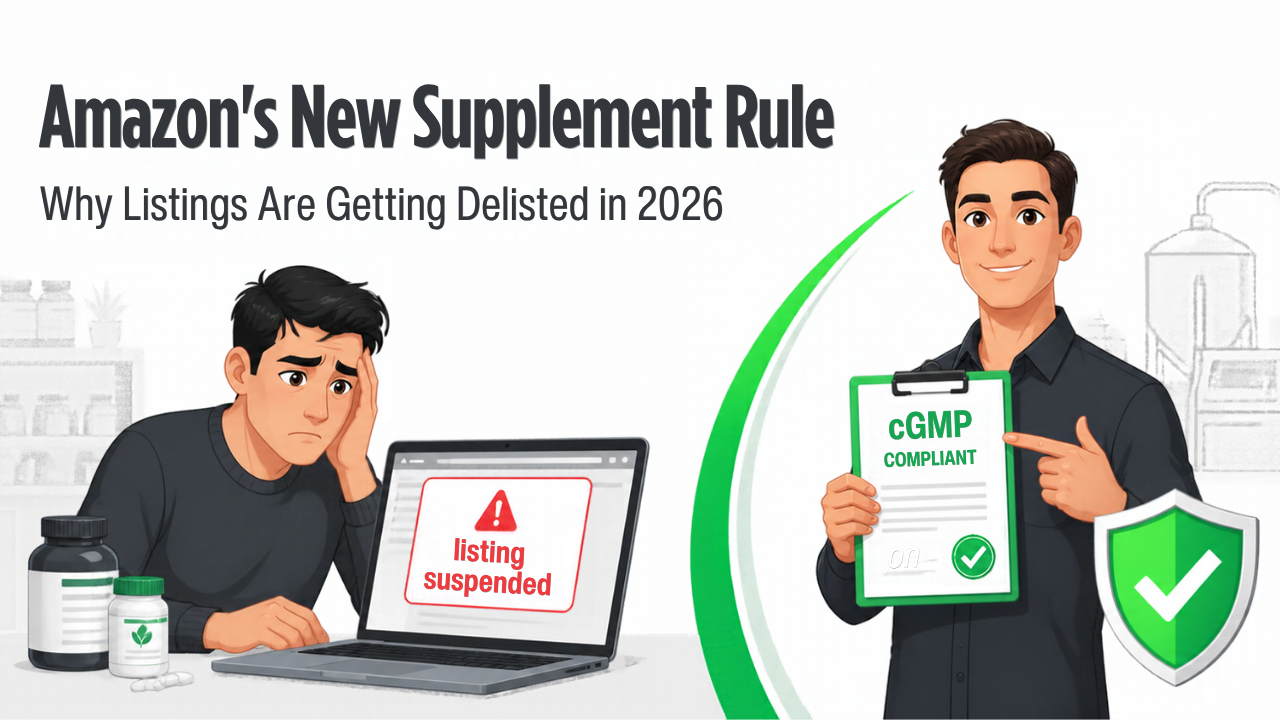
Amazon's New Supplement Compliance Gate: Why Listings Are Getting Delisted in 2026
By Firaas Dilawar, eBrandX · Published November 2, 2026 · 9 min read
Amazon quietly rewrote the rules for every dietary supplement sold on its US marketplace in 2026. Third-party cGMP certification is no longer just for weight management and sexual enhancement products. It now applies to every supplement listing, and Amazon is using an AI system to check your listing copy against your own Supplement Facts panel.
If that sounds like a small compliance footnote, it is not. Brands are already losing listings over it. This post breaks down exactly what changed, what Amazon now accepts as proof, and what to do depending on where your brand stands today.
Key Takeaways
Amazon now requires third-party TIC (testing, inspection, certification) cGMP proof for every dietary supplement on its US marketplace, not just high-risk categories.
Documents must come through an Amazon-approved TIC provider. You can no longer email Amazon your own lab reports or FDA inspection records directly.
Your listing copy, images, and ingredient weights must now match your Supplement Facts panel exactly, with no marketing language or equivalency claims.
Once Amazon contacts a seller, they typically have 90 days to submit verification before the listing is at risk of suppression or removal.
What Actually Changed on Amazon in 2026
Before this year, Amazon only required third-party cGMP certification for supplements in a short list of higher-risk categories: sexual enhancement, weight management, sports nutrition, and a few adjacent niches like bodybuilding and joint health.
Everything else was treated more loosely. A seller could submit their own documentation, and listing copy was generally treated as marketing content rather than a legal label.
That distinction is gone. As of Amazon's 2026 policy update, every dietary supplement listing on the US marketplace needs third-party cGMP verification, and the industry groups tracking this say Amazon began notifying sellers in waves starting in late 2025, with the rollout continuing through 2026.
The shift is bigger than a paperwork update. It changes what Amazon treats as "the truth" for your listing: your Supplement Facts panel, not your copywriting.
"Product listings must now be legally compliant, like labels. They used to be treated as marketing content. Now they have to match the Supplement Facts panel exactly."
What Counts as Proof, and What Doesn't
A compliant cGMP certificate is one issued by an Amazon-approved third-party TIC program, and nothing else qualifies. That single sentence trips up more brands than anything else in this update.
Plenty of supplement brands assume their existing FDA inspection history, or an internal quality audit, will satisfy Amazon. It will not. Here is the actual breakdown reported by compliance and labeling specialists tracking this update:
| Accepted by Amazon | Not Accepted |
|---|---|
| NSF/ANSI 455-2, NSF 229, UL GMP 21 CFR 111, USP, SGS, ISO 22000 | FDA inspection records |
| GFSI-benchmarked schemes: SQF, BRCGS, FSSC 22000 | Internal quality audits |
| Fast-track validation if already certified by BSCG, Clean Label Project, GRMA, Informed Choice, NSF, or USP | Consulting-firm audits |
| Documentation submitted through an Amazon-approved TIC provider | Private or first-party audits, or documents submitted directly to Amazon by the seller |
Source: cGMP program list compiled from Amazon seller policy guidance as reported by foodlabelmaker.com's regulatory hub (2026) and Vitafoods Insights (May 2026). Confirm current accepted programs directly with your TIC provider, since Amazon updates this list.
Beyond certification, Amazon is reportedly using an AI system to flag listings that don't match the Supplement Facts panel word for word. Compliance specialists following the rollout say the flagging logic looks keyword-based, which means it can misfire on perfectly legal structure-function claims.
That is the uncomfortable part. Even a compliant listing can get flagged if the wording doesn't mirror the panel closely enough, and getting a human at Amazon to review the flag is reportedly slow.
Why Amazon Is Doing This Now
Amazon's supplement category has grown fast, and so has the volume of listings with vague or inflated claims. Regulators have been pushing harder on supplement marketing across every channel this year, not just Amazon.
Our own roundup of 39 FDA, FTC, and UK ASA enforcement actions in 2026 shows the same pattern playing out across ad platforms. Amazon tightening its own marketplace rules fits that broader trend rather than standing apart from it.
For Amazon specifically, there is also a trust problem. Shoppers increasingly rely on Amazon's own AI shopping tools to pick products for them, which means Amazon has a direct incentive to make sure what gets surfaced is actually what the label says it is. A supplement listing that can't prove its own claims is a liability to Amazon, not just to the brand selling it.
What to Do, Based on Where Your Brand Stands
Not every supplement brand needs to panic today. But every brand selling on Amazon US needs a plan. Here is how to prioritize based on your situation.
If Amazon has already contacted you
Your 90-day clock is running. Start your TIC provider application this week, not after you've finished reviewing your listing copy. The certification process takes longer than the copy fixes.
If you sell on Amazon but haven't been contacted yet
Don't wait for the notice. Get a current, accepted cGMP certificate lined up now, and run your own listing-versus-panel comparison before Amazon's AI does it for you.
If you're launching a new supplement on Amazon
Build the cGMP certification and exact-match listing copy into your launch timeline from day one. Treat it the same as nailing your SKU setup and your Brand Registry verification. This is not an optional nice-to-have anymore.
eBrandX's Amazon full-service management already includes lab testing (COA) review as part of our compliance process, plus a walkthrough call for Brand Registry verification. If this update has you wondering whether your current listings would survive a review, that is exactly the kind of audit we run on day one with a new client. You can see what that looks like in our compliance audit breakdown.
Common Mistakes Brands Are Making
Mistake: "Our FDA inspection history should count as proof."
It does not. Amazon's accepted list is built around third-party TIC certification programs, not FDA inspection records or internal audits.
Mistake: "Our listing copy is just marketing, it doesn't need to match the label."
That assumption is exactly what changed. Listings are now treated as label extensions, and copy that drifts from the Supplement Facts panel is a delisting risk.
Mistake: "We'll deal with it once Amazon actually flags us."
TIC certification is not instant. Waiting until you're flagged means starting the clock on a 90-day deadline with zero head start.
Mistake: "We only need this for our best-selling SKU."
The policy applies across the board, not just to flagship products. Every active supplement listing is in scope.
FAQ
What is a TIC provider?
TIC stands for testing, inspection, and certification. It is a third-party organization, approved by Amazon, that verifies your supplement facility meets cGMP standards and issues the certificate Amazon will accept.
Does this policy apply outside the United States?
The cGMP certification mandate applies to Amazon's US marketplace. Separately, Amazon has also asked sellers in Germany, France, Spain, and Italy to show proof that their product labels were submitted to local authorities.
What happens if Amazon's AI flags a compliant listing by mistake?
You can work with your TIC provider on resolution before results are sent to Amazon. Reports from sellers describe the appeals process as slow, so the safest move is minimizing the chance of a flag in the first place by keeping copy tightly aligned to your panel.
How long do we have to comply once Amazon reaches out?
Sellers who have been contacted typically report a 90-day window to submit verification. There is no public, fixed date for when any specific brand gets notified, since Amazon is rolling this out in waves.
Does this affect private label supplement sellers too?
Yes. Private label brands are not exempt. If your product is a dietary supplement sold on Amazon's US marketplace, the same cGMP and listing-matching rules apply to you.
Can we fix our listing copy ourselves without a TIC provider?
You can and should clean up your listing copy right away so it matches your Supplement Facts panel. But copy cleanup alone does not satisfy Amazon's certification requirement. You still need a current cGMP certificate issued through an Amazon-approved TIC provider to stay fully compliant.
Bottom Line
Amazon has moved supplement compliance from a background requirement to a front-line gate. The brands that treat this as a real deadline, not a rumor, are the ones that keep their listings live through 2026 and beyond.
If you are not sure whether your current Amazon listings would pass a line-by-line review against your own Supplement Facts panel, that is worth finding out before Amazon's AI finds out for you. It is also worth reading our breakdown of how Amazon's Rufus AI is already reshaping which products get shown to shoppers, since both changes point the same direction: Amazon is tightening what makes a listing trustworthy enough to stay visible. And if you want the fuller picture of how fast the regulatory environment is moving across every channel, not just Amazon, see our recent roundup of 39 supplement ad enforcement actions in 2026.
Not sure if your Amazon listings would survive a cGMP and Supplement Facts review? eBrandX runs that exact compliance check as part of our Amazon full-service management.
Book a Free Strategy CallWant templates, SOPs, and a community of supplement brand owners working through changes like this one together? Join Supplements Scaling Insiders.
Sources: Vitafoods Insights, "What does Amazon's 2026 supplement update mean for brands?" (May 2026); foodlabelmaker.com Regulatory Hub, "Amazon's Supplement Update 2026" (2026).